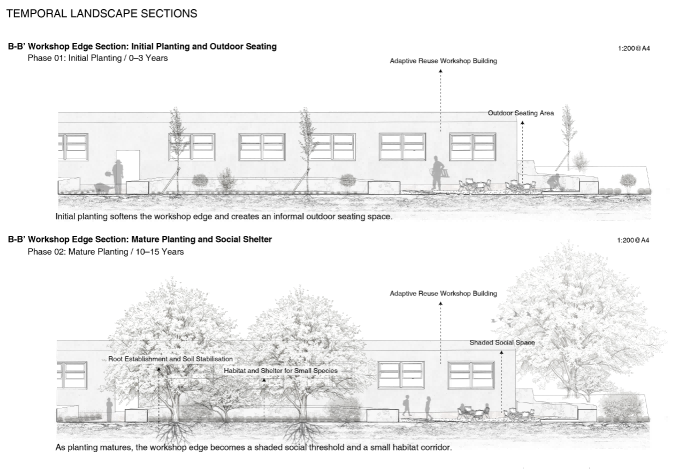
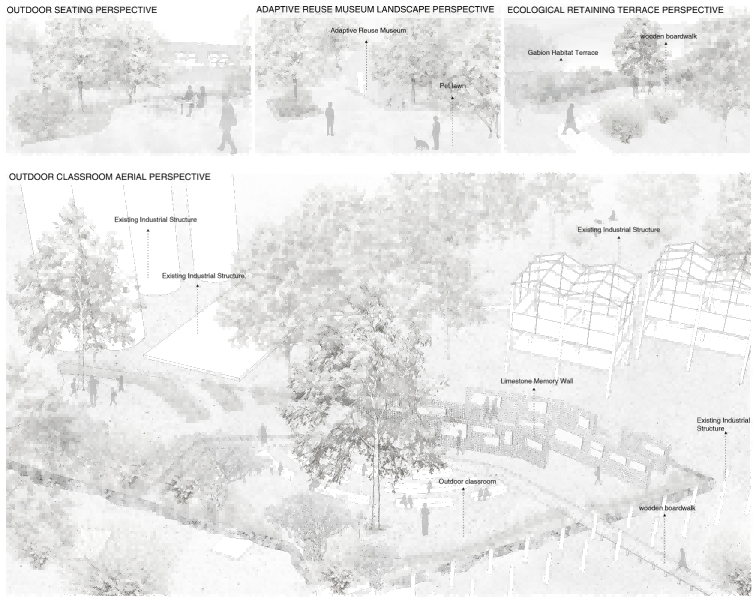
Dynamic More-than-Human Refuge Park reimagines Liban Quarry in Krakow as an adaptive landscape where geological traces, historical memory, seasonal water, ecological succession and public life are organised into one evolving system. Rather than treating the abandoned limestone quarry as an empty post-industrial site to be repaired or overwritten, the project works with its existing topography, ruins, limestone edges, wet depressions, spontaneous vegetation and material remains as foundations for future transformation.
The proposal responds to Krakow’s wider hydrological pressure by using the quarry’s low-lying basin as a flood-adaptive and ecologically productive landscape. Seasonal water is retained and allowed to fluctuate, forming wetland habitats that support amphibians, dragonflies, birds, insects, wetland plants and small mammals. Public access is carefully structured through a sequence of gradients: from the urban entrance and social edge, to learning and memory spaces, to controlled observation routes, and finally to a protected more-than-human refuge core.
Through adaptive reuse, on-site material recovery, raised classrooms, boardwalks, planting succession and restricted habitat zones, the design balances human experience with ecological protection. Memory is not expressed through a single monument, but through walking, material contact, ruins, water movement and vegetation growth. The project therefore proposes a new type of park: not a fixed recreational landscape, but a temporal refuge where water, plants, animals, people and site traces continue to shape the landscape together.