


What if architecture begins with an almanac, not a blueprint?
An almanac is a cyclical, projected schedule that coordinates when and how operations happen, based on known material cycles and constraints (of seasonal harvest, extraction-recovery dynamics, and scarcity cycles) This thesis proposes an urban almanac for post-consumption urbanism, converting a buried extractive ground and post-retail fabric into a repeatable system for material recovery and housing assembly amid Edinburgh’s housing emergencies.


Hazwan Husain
A Quarry's Almanac : System of Production in Post-Consumption Edinburgh
Follow:
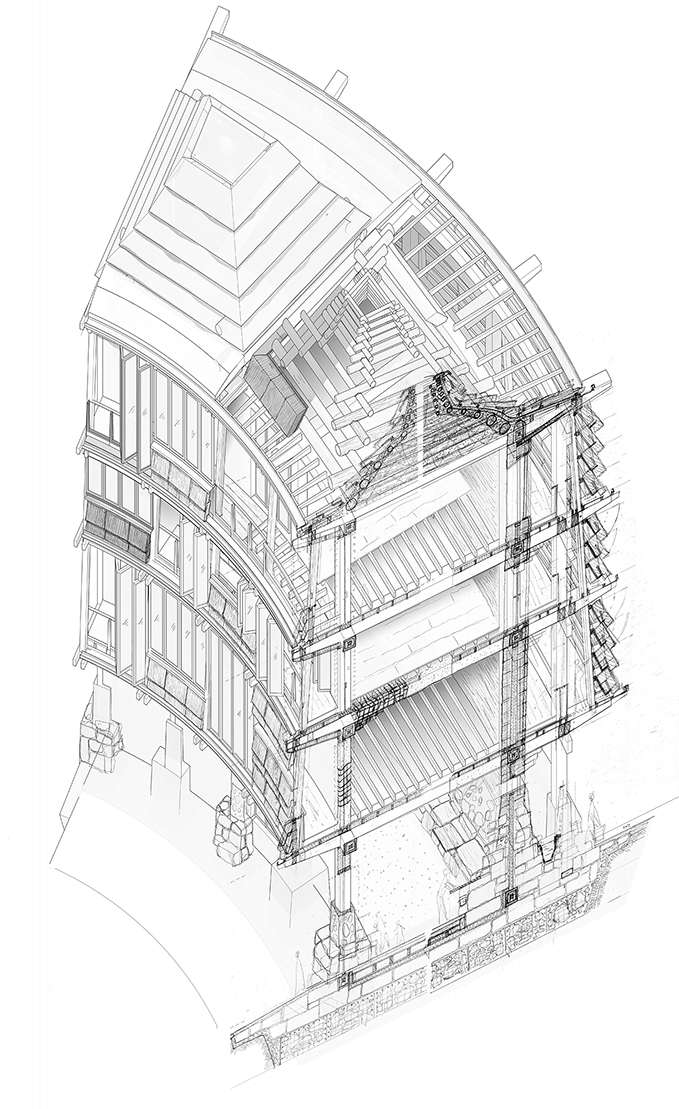
Project description
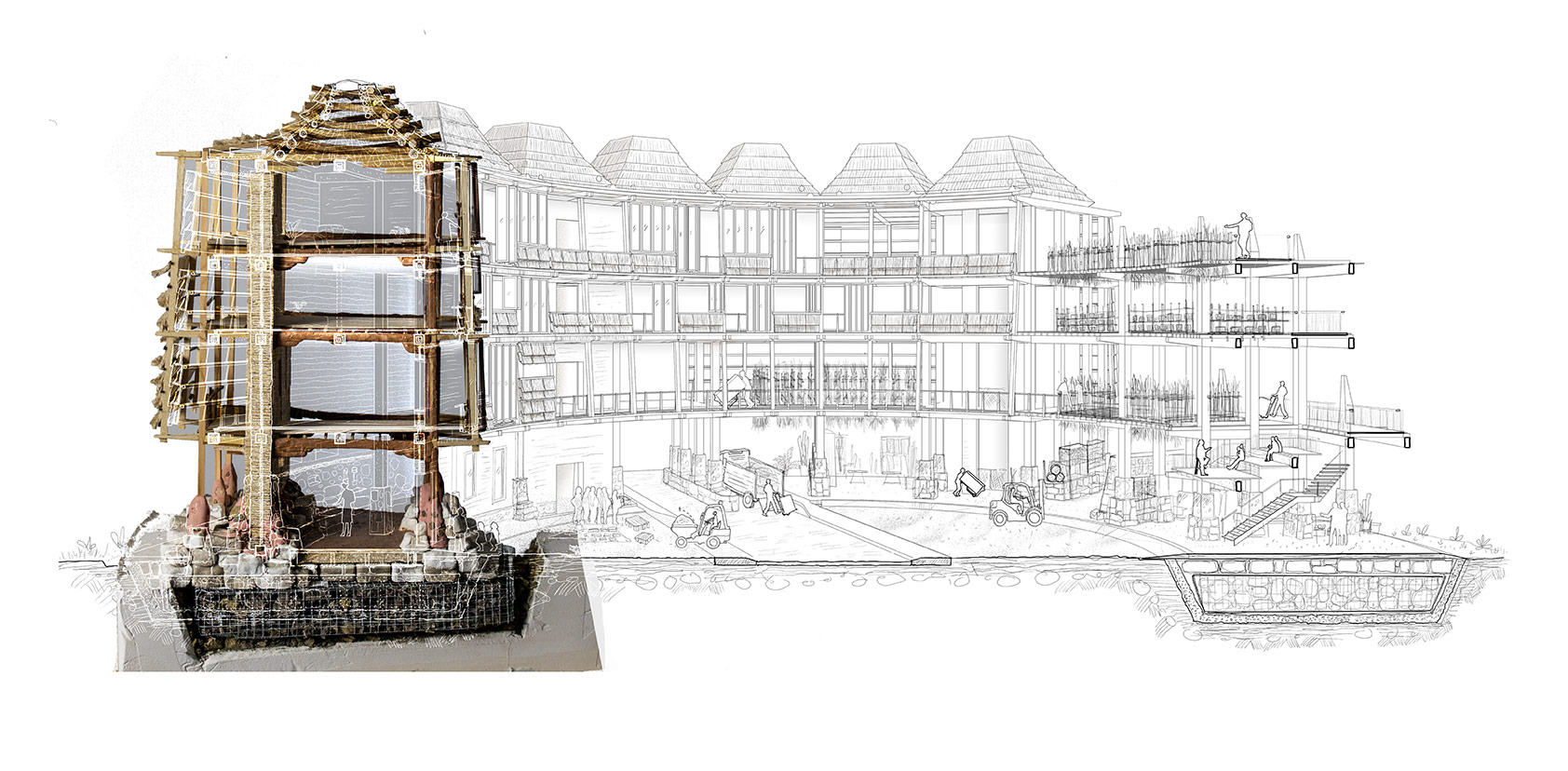


Builder's Yard | Sectional Perspective
Abstract
The project occupies a 24-acre retail park built over the former Craigleith Quarry, once a major sandstone source for Edinburgh’s New Town before being backfilled with one million m³ of inert material. This thesis converts the extractive legacy site into housing capacity through an almanac-governed sequence, situating tectonics within local contingencies and vernacular potentials. A mode of Critical Regionalism, following Kenneth Frampton, is understood as a resistance to placeless modernisation through tectonic and topographic specificity
Its production model draws on Christopher Alexander’s alternative vision of housing: a patterned language of assembly, and variation rather than a fixed blueprint. This position is grounded in a hands on live-build project at Lauriston Farm, material harvest, and manual labour. The almanac gives this theoretical position procedural form. Typochronology projection ties each programmatic typology to its time and each time to an operation.
A sequence of production is unfolded across multiple time frames: re-excavation of the backfilled quarry, introduction of material reclamation and production pipeline, retrofitting the retail warehouses into housing, and restoration of the re-quarried ground for curation and bioregenerative material cultivation. Together, these protocols invite conversation on rethinking the cyclical rhythm of the city’s resources metabolic process, a seasonal shifting of extraction, inhabitation, and cultivation, forming an urban almanac that is replicable to similar sites.
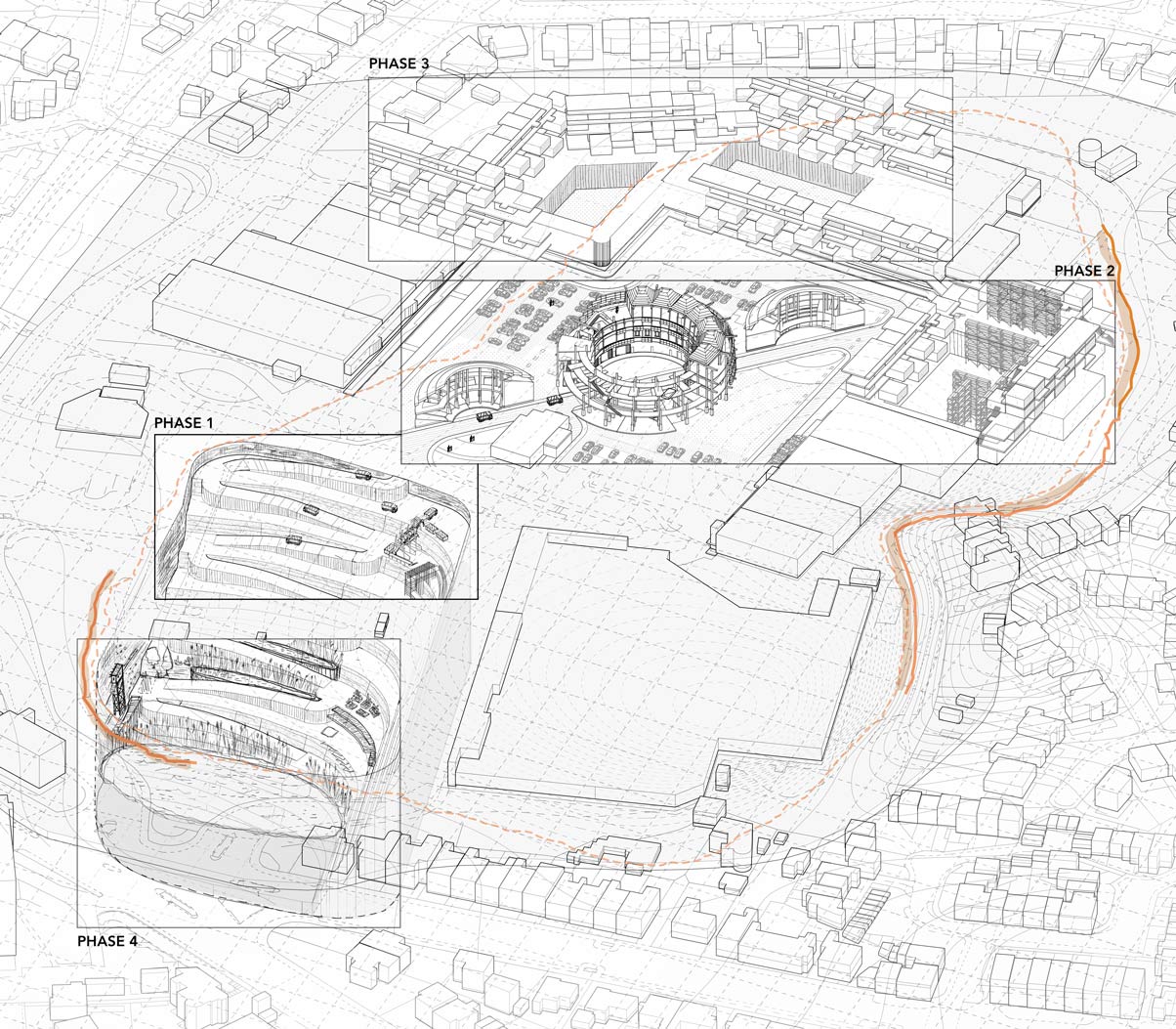
Craigleith Retail Park : Phases Projection | Site Isometric
Typochronology Projection
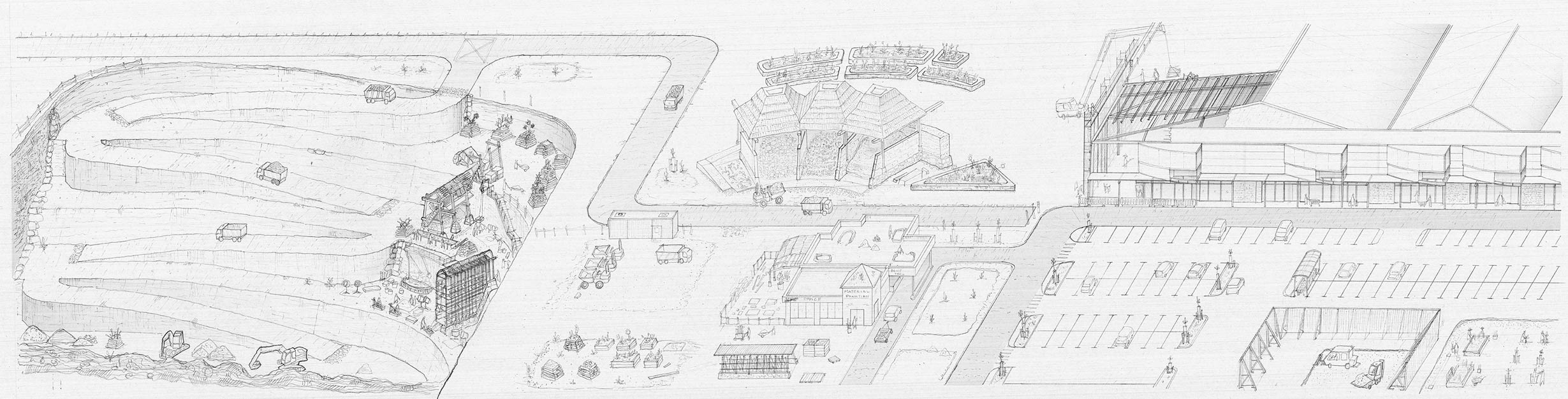
Phase 1 : Quarry Re-excavation

Phase 2 : Infrastructure of Production
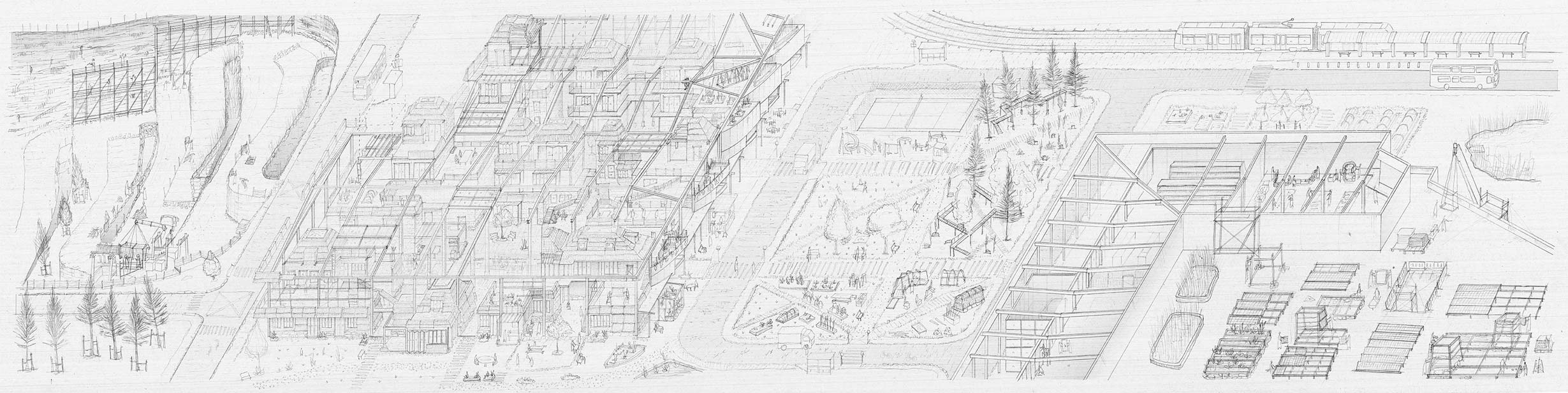
Phase 3 : Housing Conversion

Phase 4 : Infrastructure of Restoration
Curatorial Object : Reading Freeze Frames in Chronology
The almanac is drawn as an emakimono, using the sequential logic of the Japanese handscroll as a method of architectural projection, through which typological programmes, material cycles, and construction operations gradually unfold across time rather than appearing as a fixed blueprint. The proposal spans over four phases, portrayed through panoramic freeze-frames that each represent a moment in time, accompanied by key typological models and sectional drawings.

Curatorial Object : Studio Installation

Curatorial object close-up : phases projection

Close up of resources and scar[city] mapping model
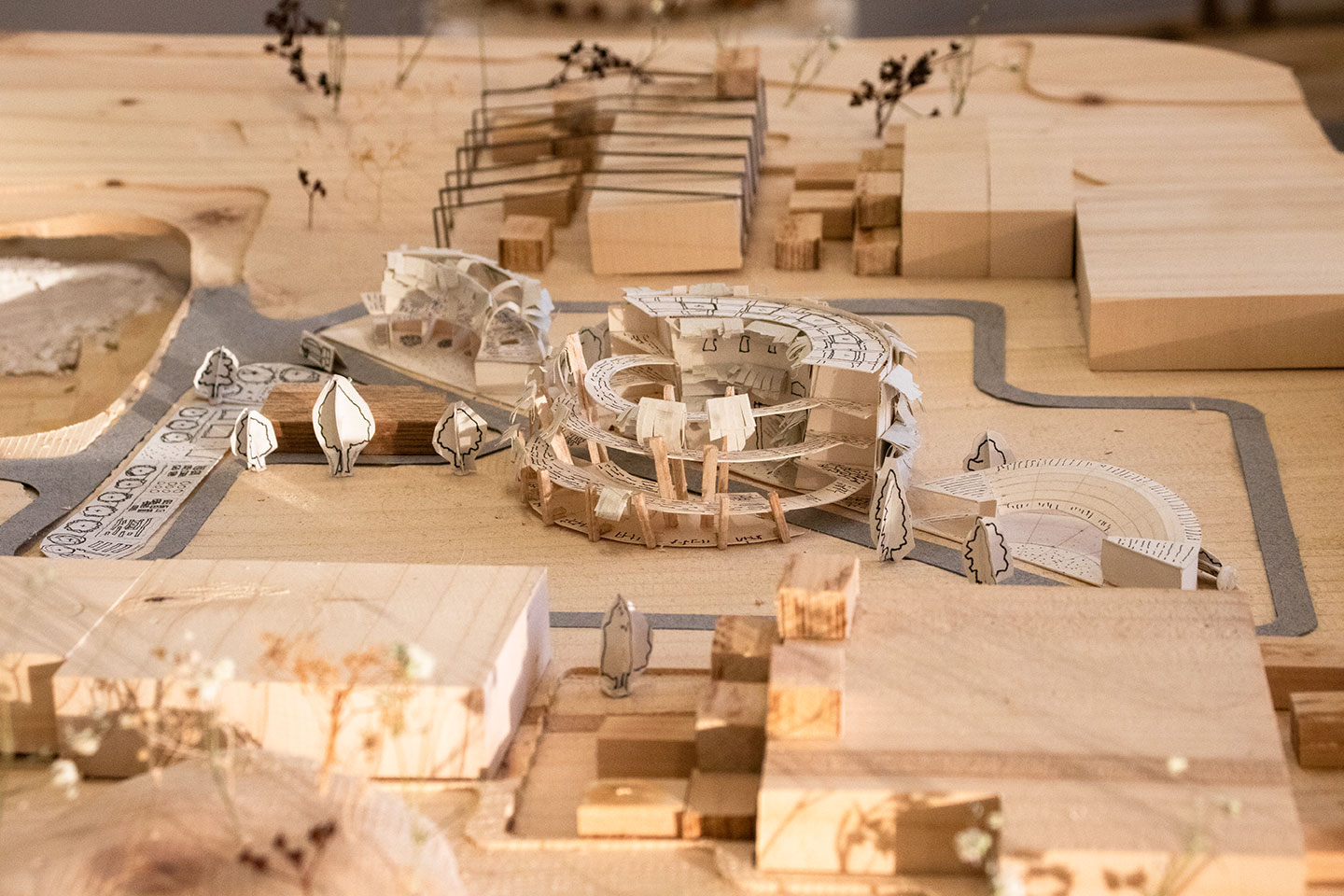
Site model of Builder's Yard on reduced car park area
Phase 1 : Quarry Re-excavation (2025)
First phase begins with re-excavating portions of the extensive car park, which sits on artifically backfilled ground covering the former quarry void (claimed to be previously reaching depths of up to 100 metres).
This process aims to reclaim inert waste, speculated to consist largely of overburden coarse aggregate (e.g. stones and gravel), as an immediate building resource. In parallel, selected pockets of car park are gradually converted into timber-growing plots and constructed reedbed planters, to be harvested annually.
Dismantling works across the decaying retail plots take place concurrently, alongside a phased reduction in the capacity of both the retail park and its parking infrastructure.
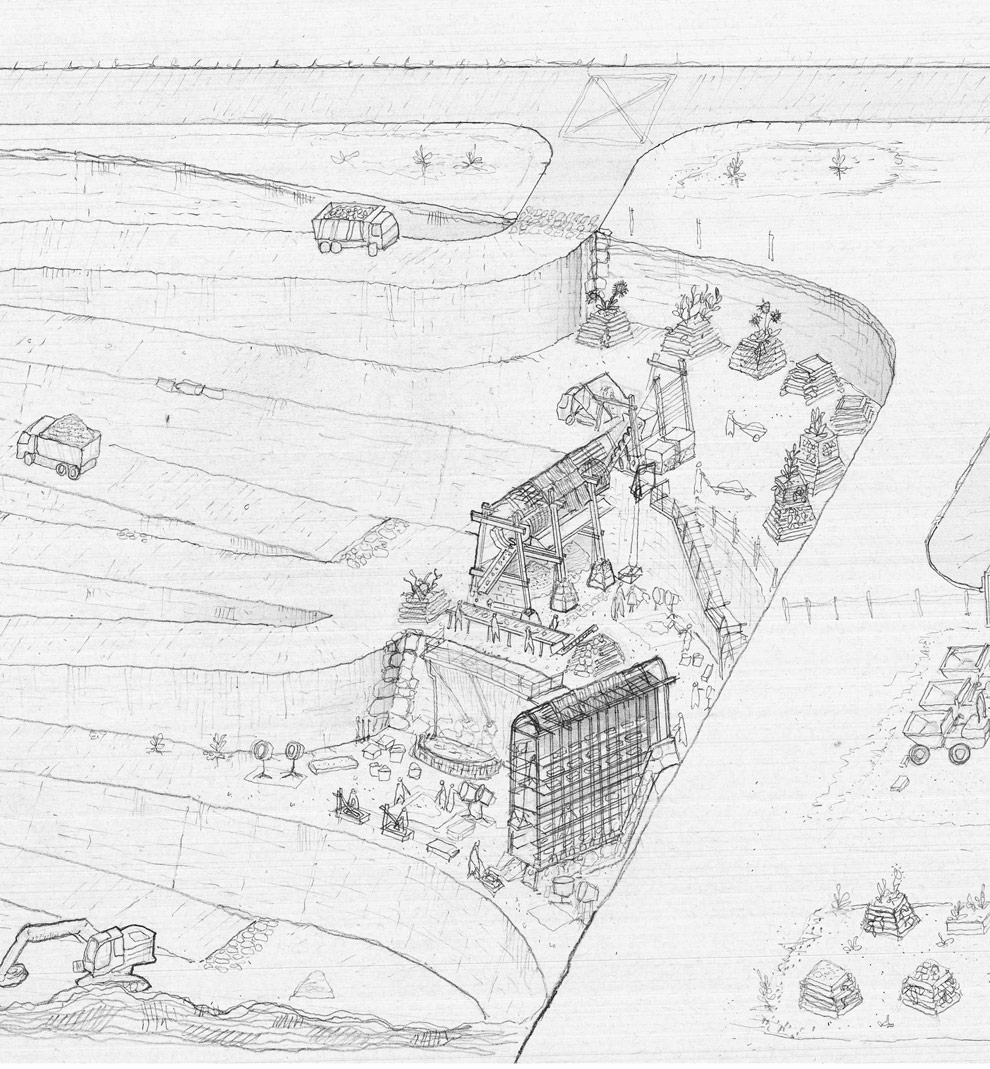
Re-excavated quarry on retail car park area
Phase 2 : Infrastructure of Production (2030)
Alexander argues that in today’s society, the process of construction (of mass housing) is almost completely centralised. Control over construction activity, along with the political decisions behind it, is often distant from the neighborhood in which building (both noun and verb) actually takes place.
He envision a decentralised model of practice, where builders operate at the scale of a neighbourhood. The builders’ yard acts as a homebase, with the capacity to process locally harvested materials, manufacture components and becoming a nucleus for incremental growth. Once construction is complete, the yard can transition into a shared community asset. Within this phase, a process of active co-authorship unfolds as housing emerges across the converted retail plots.
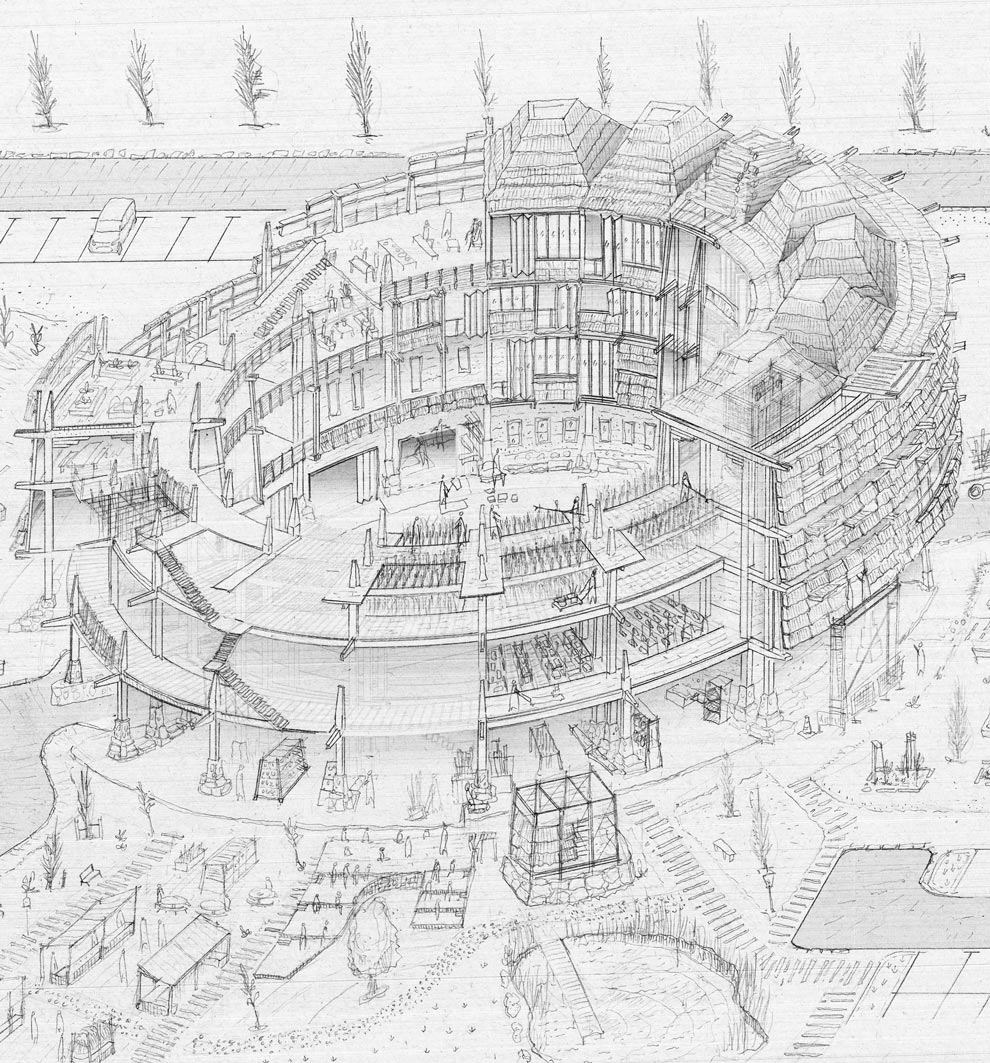
Builder's Yard : Workshop, Quarters, Community Spaces and Drying Tower
Phase 3 : Housing Conversion (2050)
This phase addresses the city’s housing emergency by repopulating large, decaying retail warehouses with housing. Land scarcity is mitigated through retrofitting , converting consumption-driven retail fabric into purpose-built Community Land Trusts (CLTs) that preclude housing stocks from speculative markets.
Decision-making across spatial scales (of site and building) is negotiated directly between builders and residents, guided by Alexander’s Pattern Language. Retail provision, food production and access to public spaces are democratised through locally owned cooperatives and trusts.
This phase also anticipates the outcomes of ongoing plans for expanded mobility network in Edinburgh, including tram expansion and cycling infrastructure.
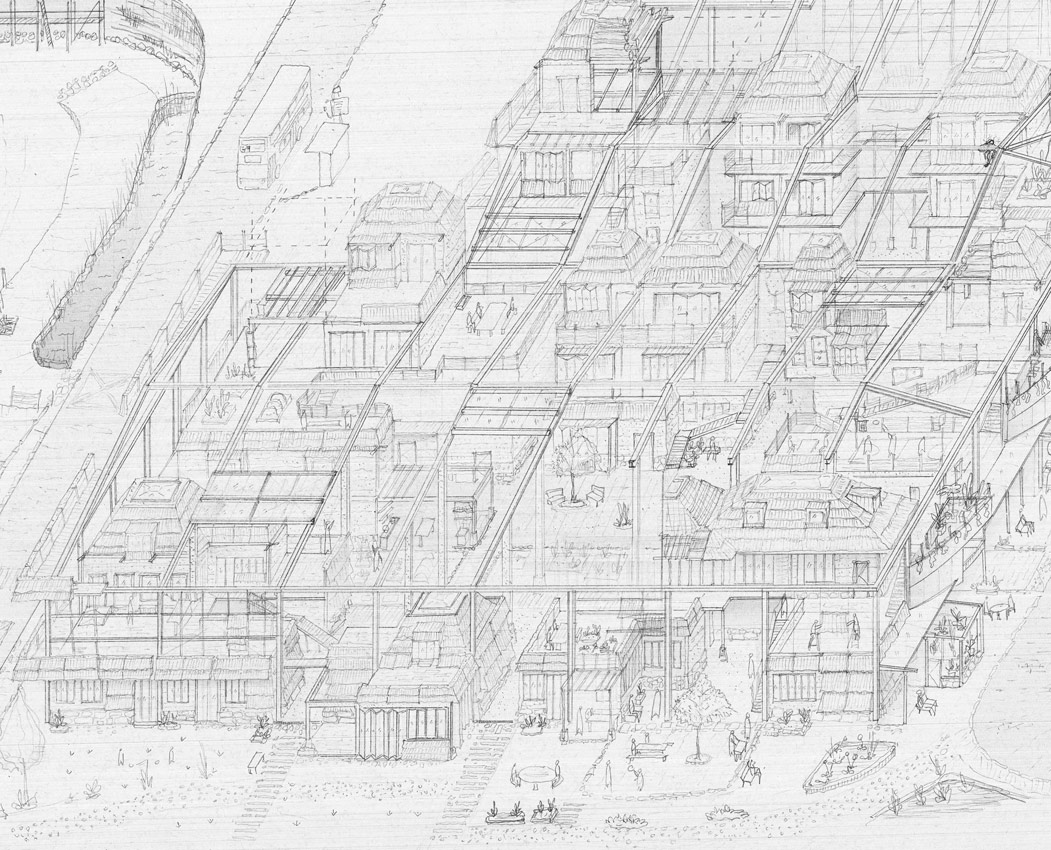
Housing clusters converted from decayed retail warehouse
Phase 4 : Infrastructure of Restoration (>2100)
The re-excavation project revealed a portion of the original quarry’s wall on along its perimeter. This creates an oppurtunity to curate the city’s extractive legacy by introducing public walkways, galleries, and recreation spaces along the exposed faces and quarry benches.
The void, once again a by-product of extraction, is deliberately flooded this time to support the large scale cultivation of locally grown cuilc (water reeds) for future building material supply. Fully functioning constructured marshlands and timber plots begin to yield from the seeds sown in earlier phases.
This phase also anticipate the continuation of a new cycle of material production, collective ownership and micro energy generation that responses to future demand.
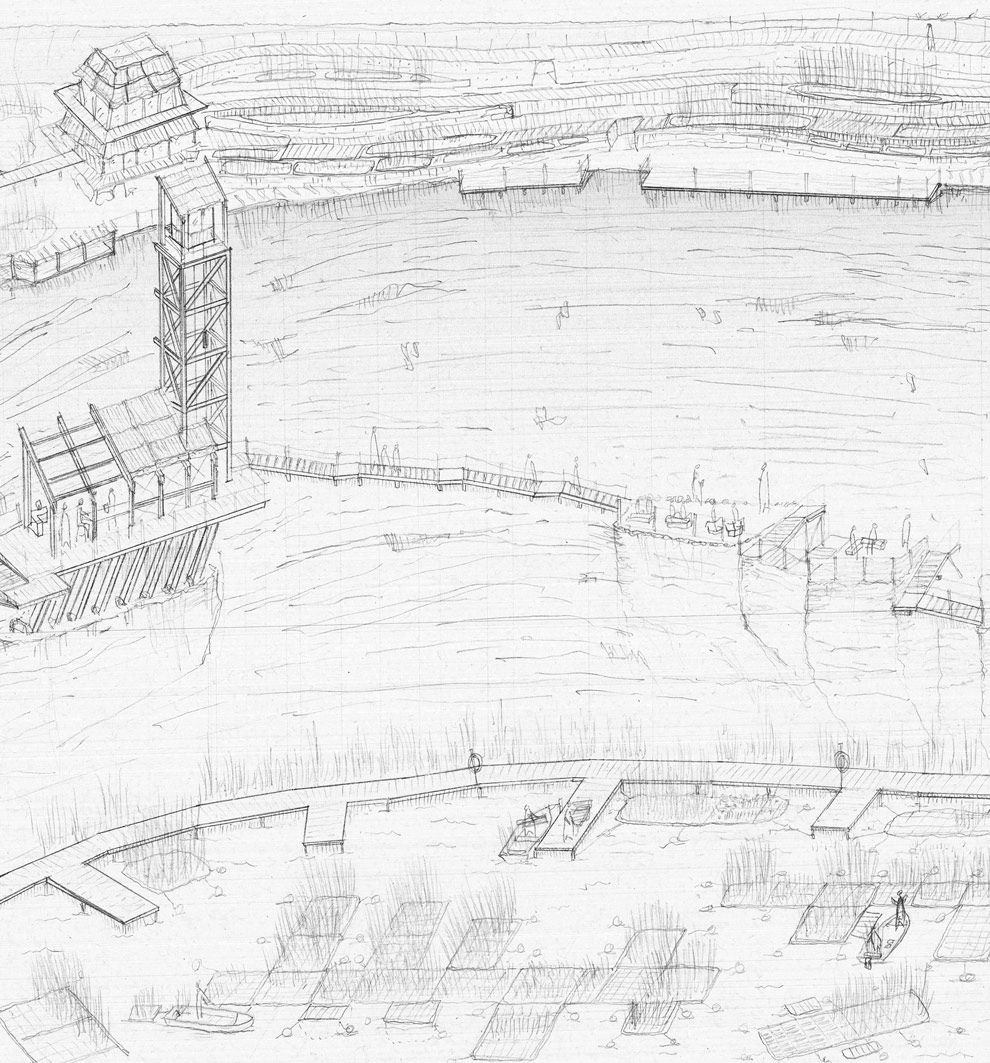
Quarry wall gallery & flooded pit for artificial reedbeds
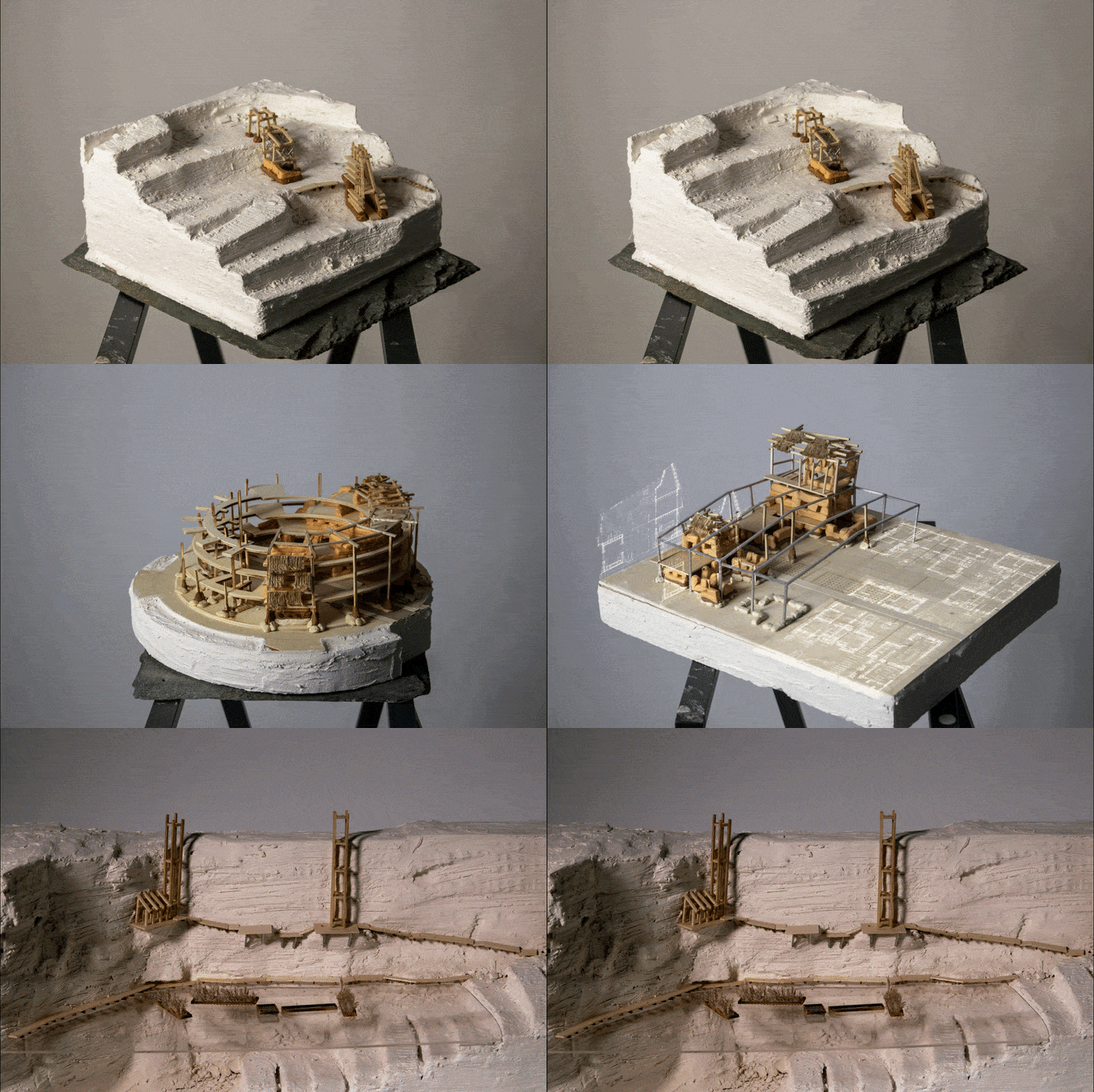
Key typologies model | 1:200
Operational Typologies
Slices of building typologies across each phases that uses the same tectionic kernel with variations to suit the programme.
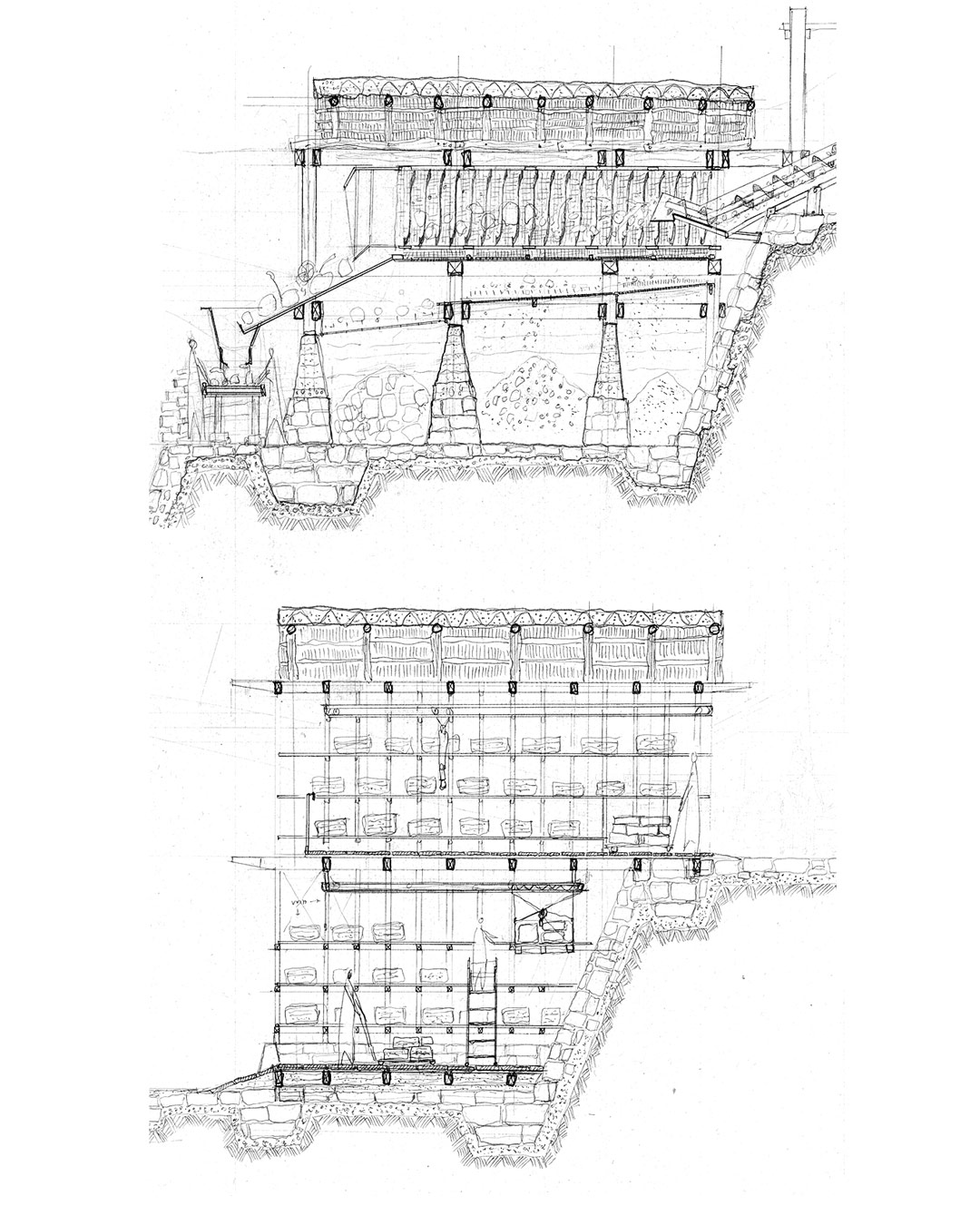
Phase 1 | Trommel Filtration & Drying Tower
Phase 2 | Builder's Yard
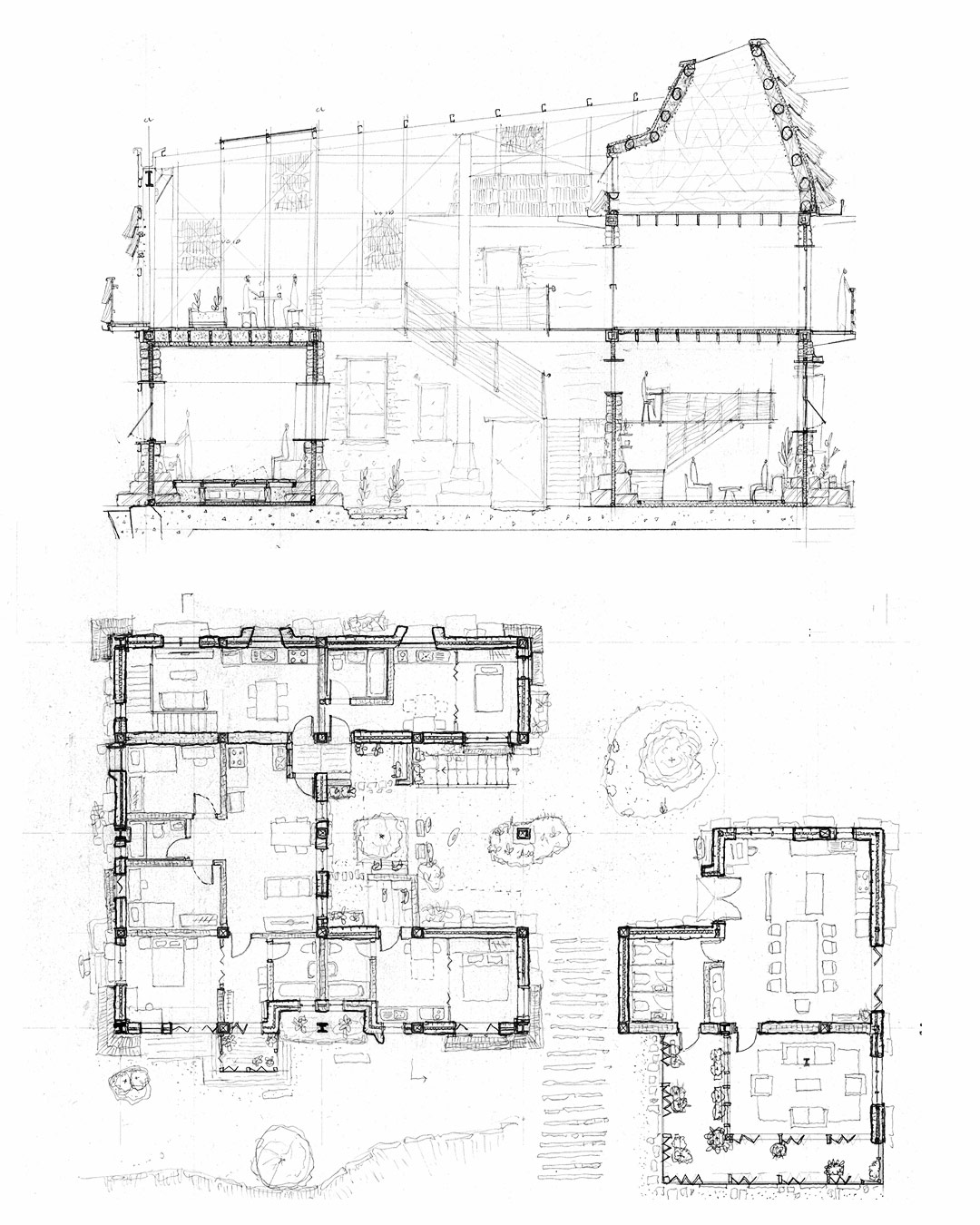
Phase 3 | Housing Cluster from Converted Retail Warehouse
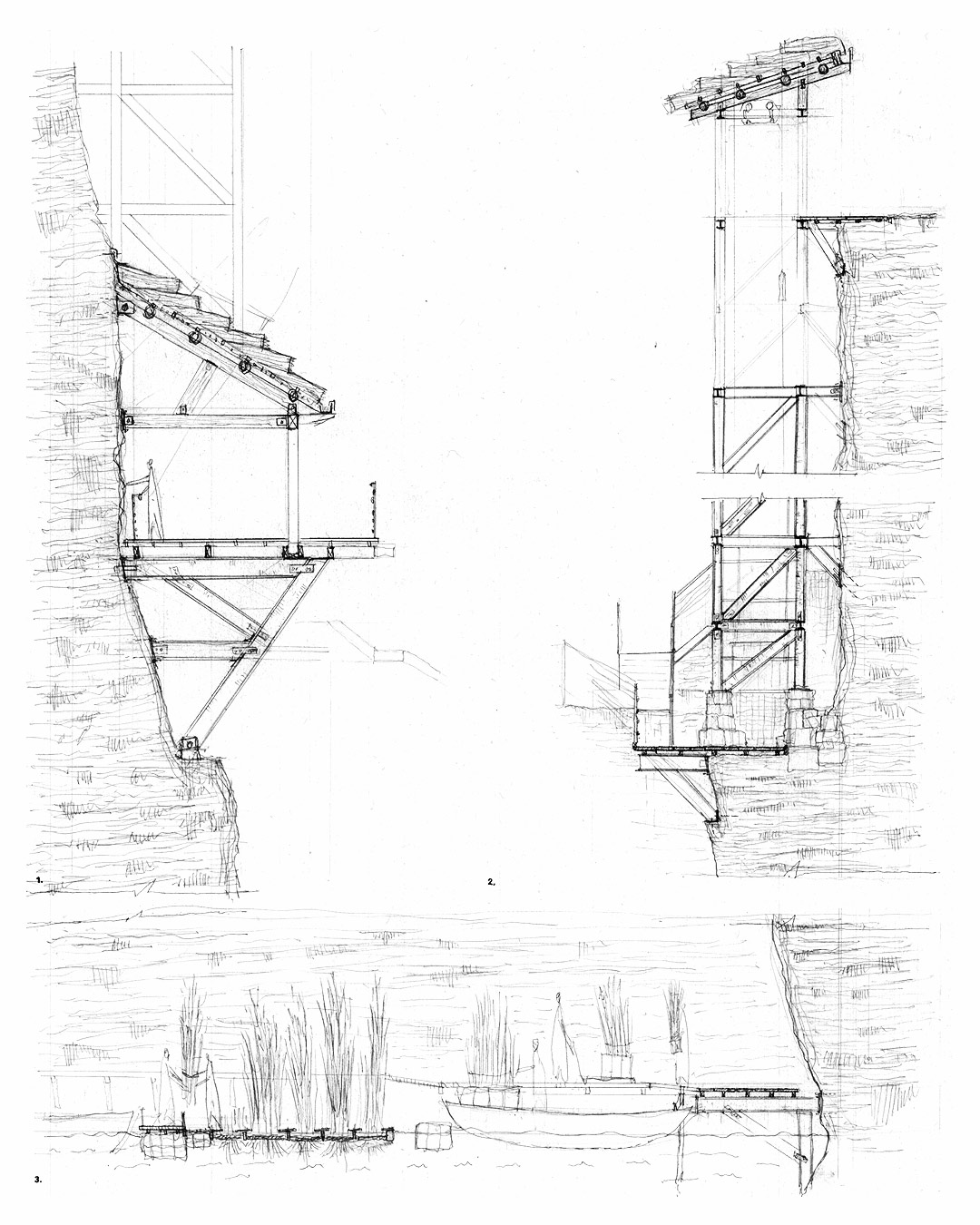
Phase 4 | Quarry Wall Gallery & Artificial Floating Reedbedss
Drawing on Regional Intelligence
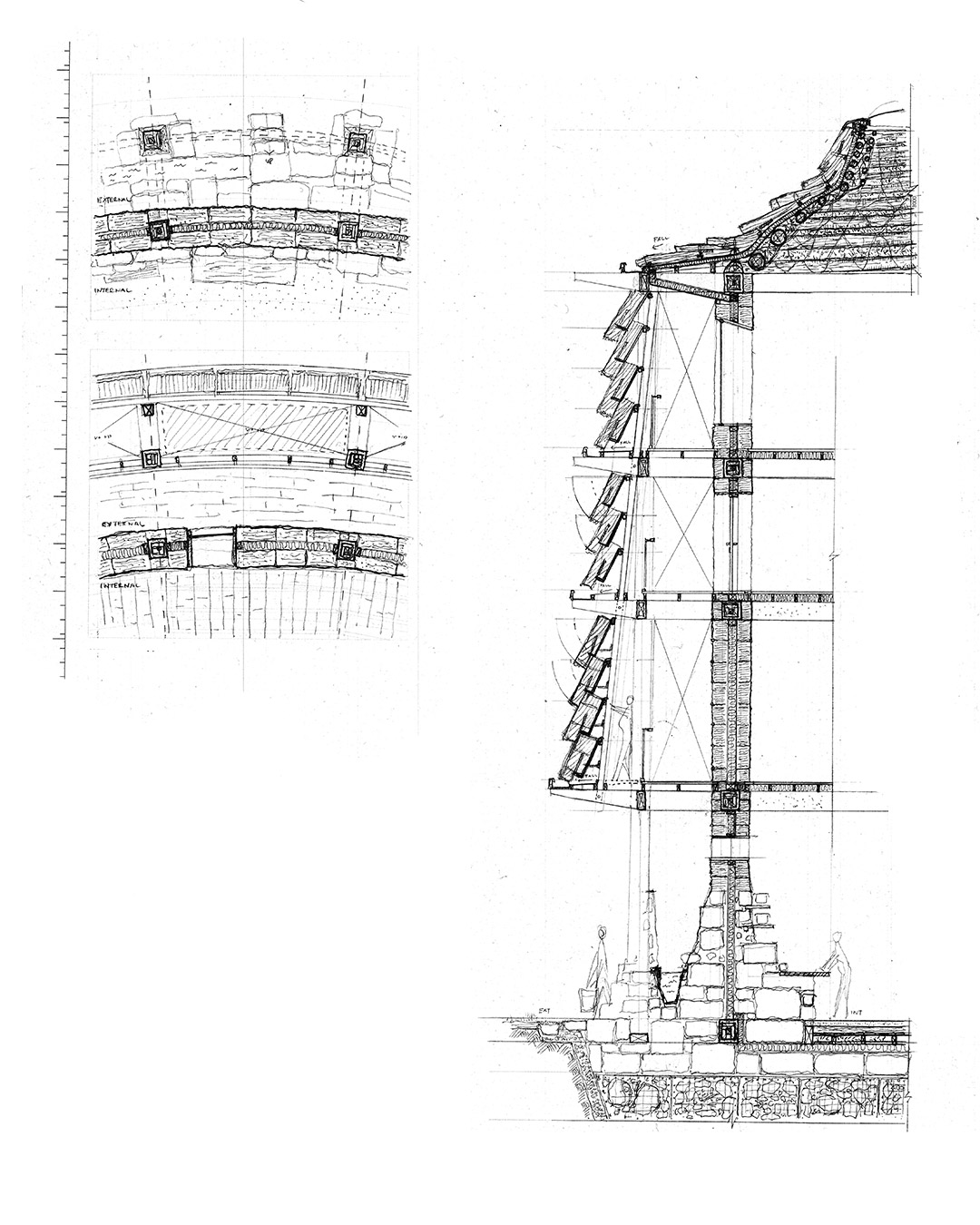
The technical resolution of this speculative proposal zooms into a slice of Builders’ Yard typology in Phase 2 (Infrastructure of Production) .
In developing the tectonic language, Kenneth Frampton’s view on Arrière-garde position plays a role in distingushing how vernacular and regional building practices can mediate the impact of universally mechanised production. What emerged here is not merely replicating vernacular technique, but an advancement of the essense and ideology behind this situated knowledge to accomodate modern standard of production and living.
“Architecture can only be sustained today as critical practice if it assumes an Arrière garde position, that is to say, one which distance itself equally from ; the Enlightenment myth of progress, and from a reactionary, unrealistic impulse to return to the architectonic forms of preindustrial past." - Kenneth Frampton, Towards a Critical Regionalism : Six Points of an Architecture of Resistance.
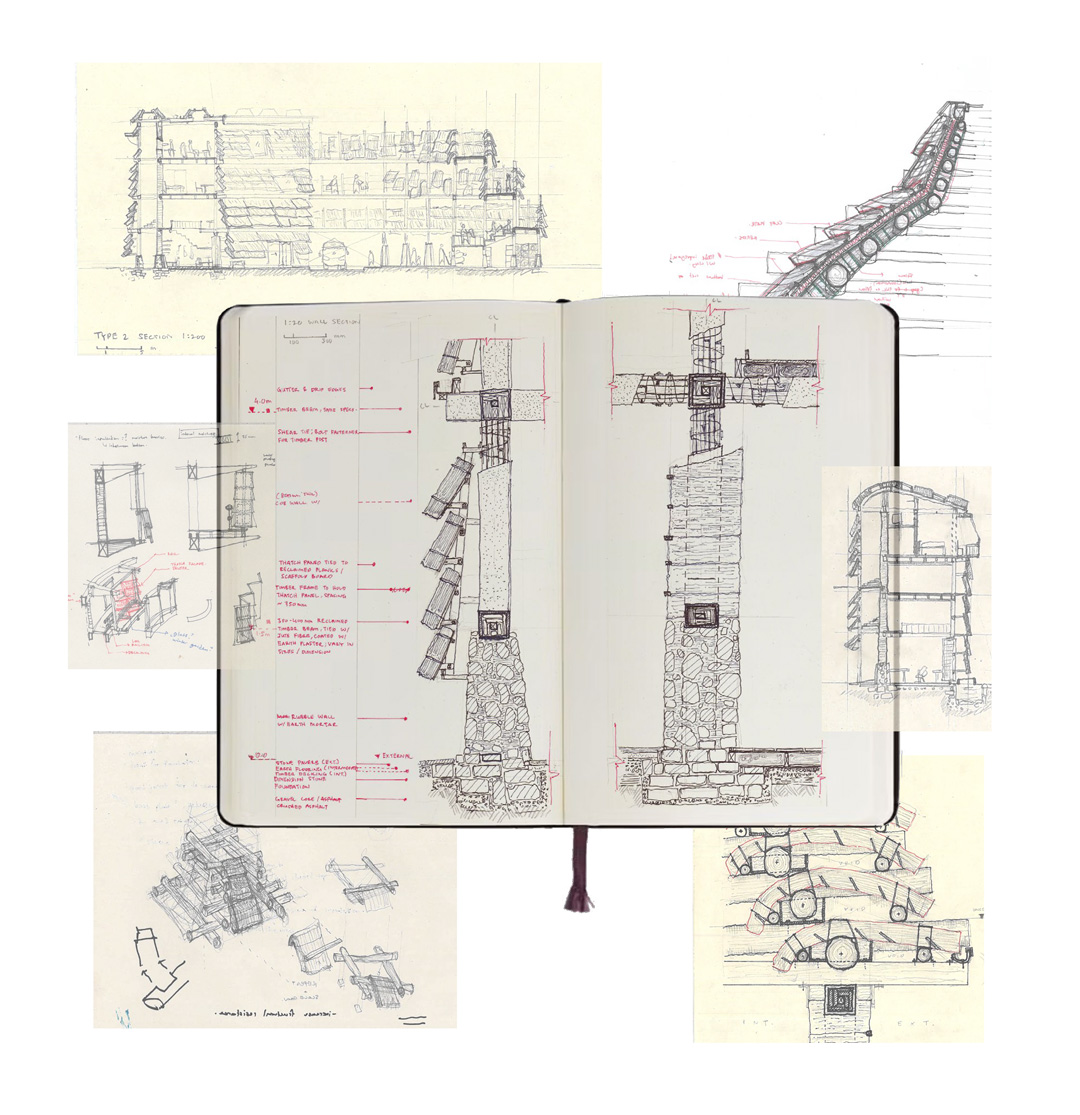
Development sketches of tectonic resolution
Tectonic Resolution

Embraced Wood System : Composite Reclaimed Timber | Isometric
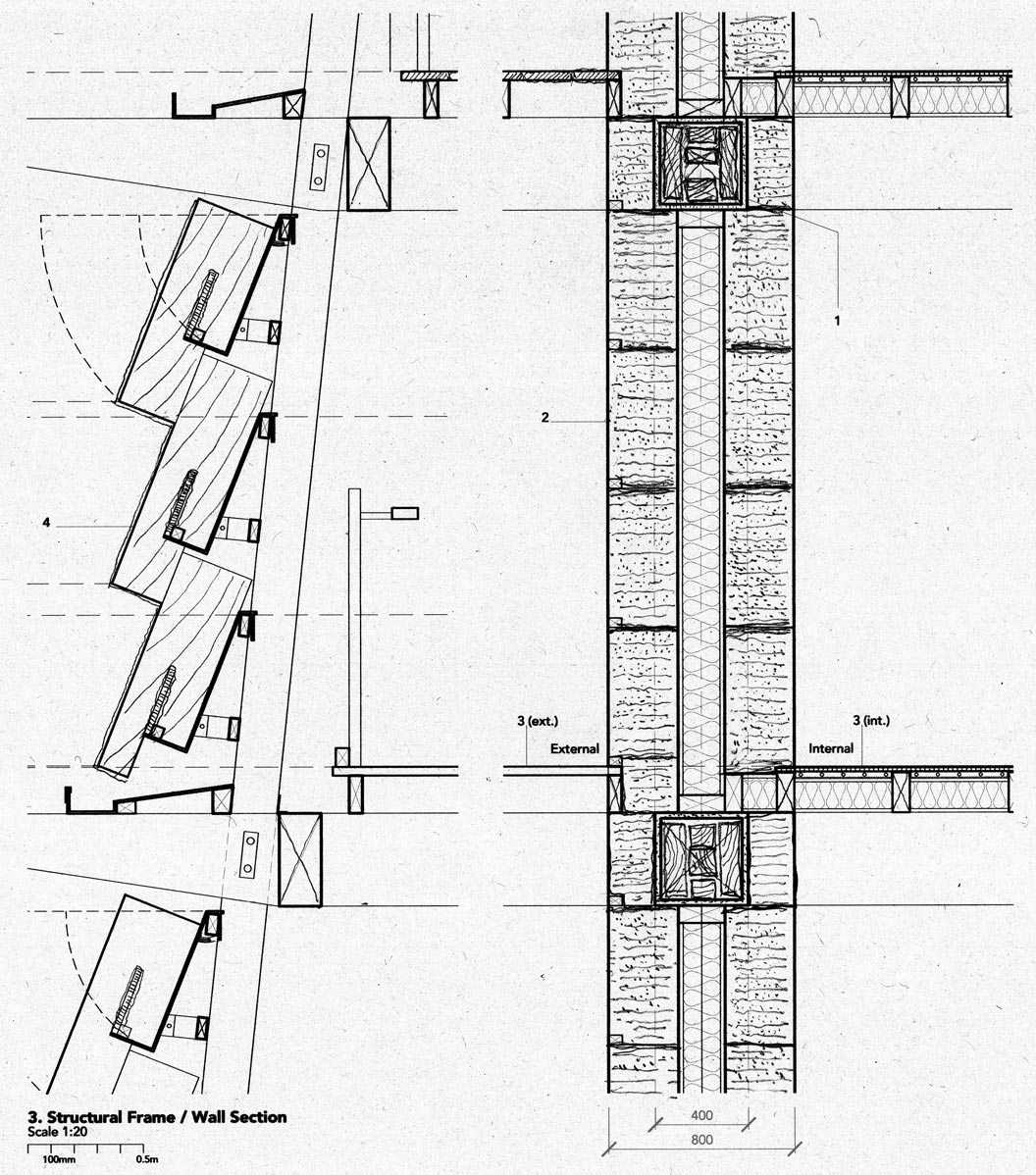
Embraced Wood System | Section 1:20

Embraced Wood System | Section 1:5

Reciprocal Roof System | Isometric
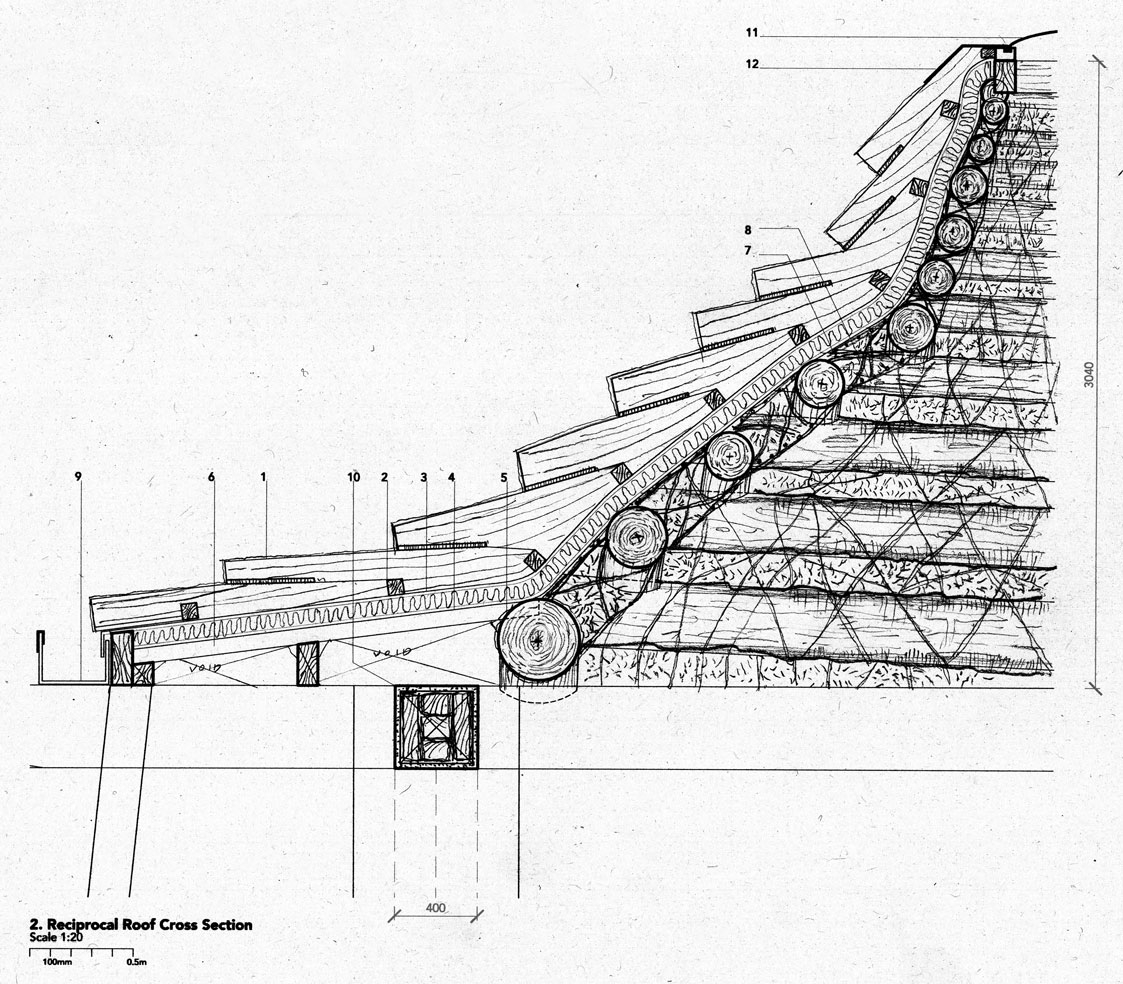
Reciprocal Roof System | Section 1:20

Reciprocal Roof System | Section 1:5
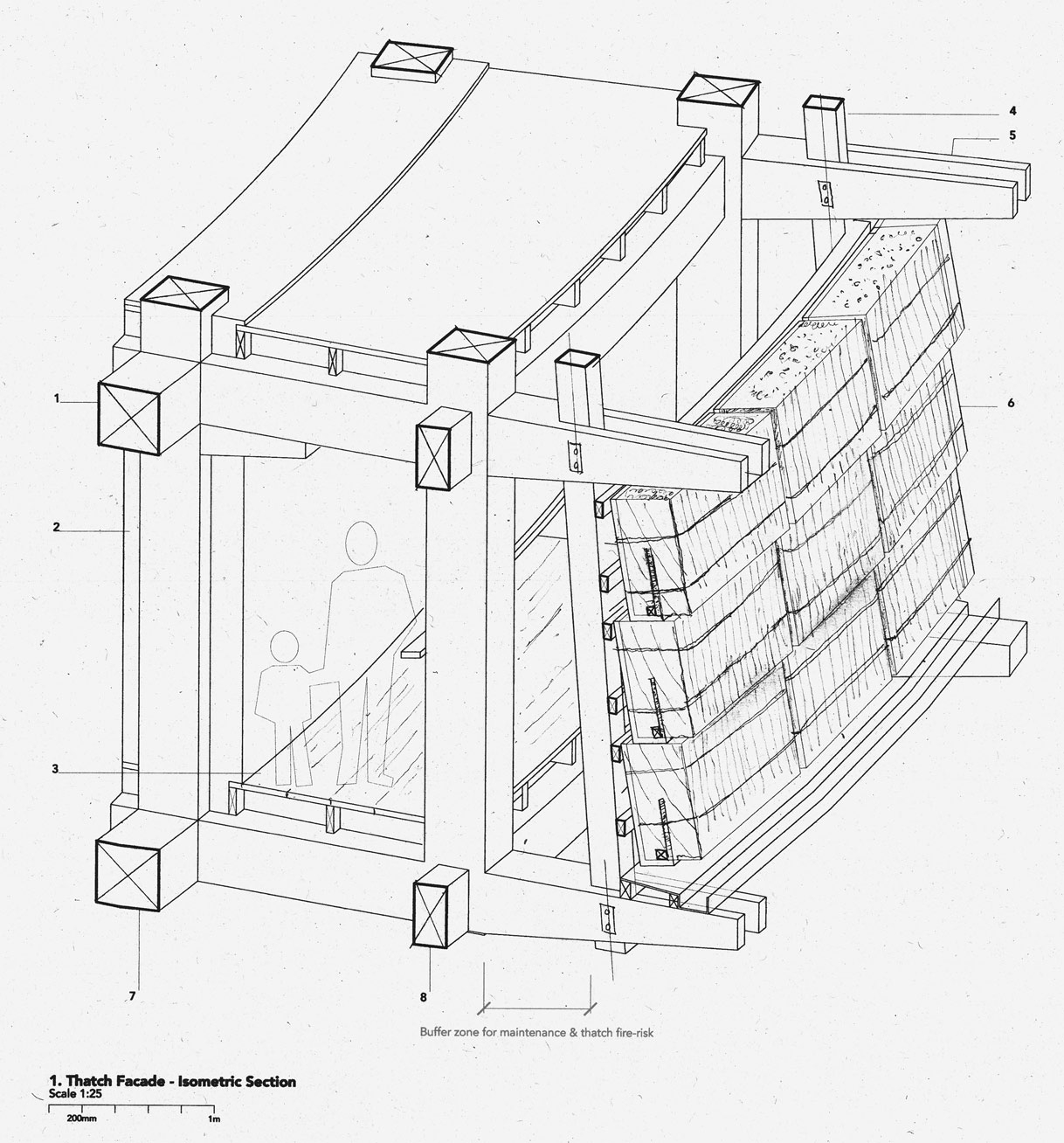
Thatch Windbreak Facade | Isometric
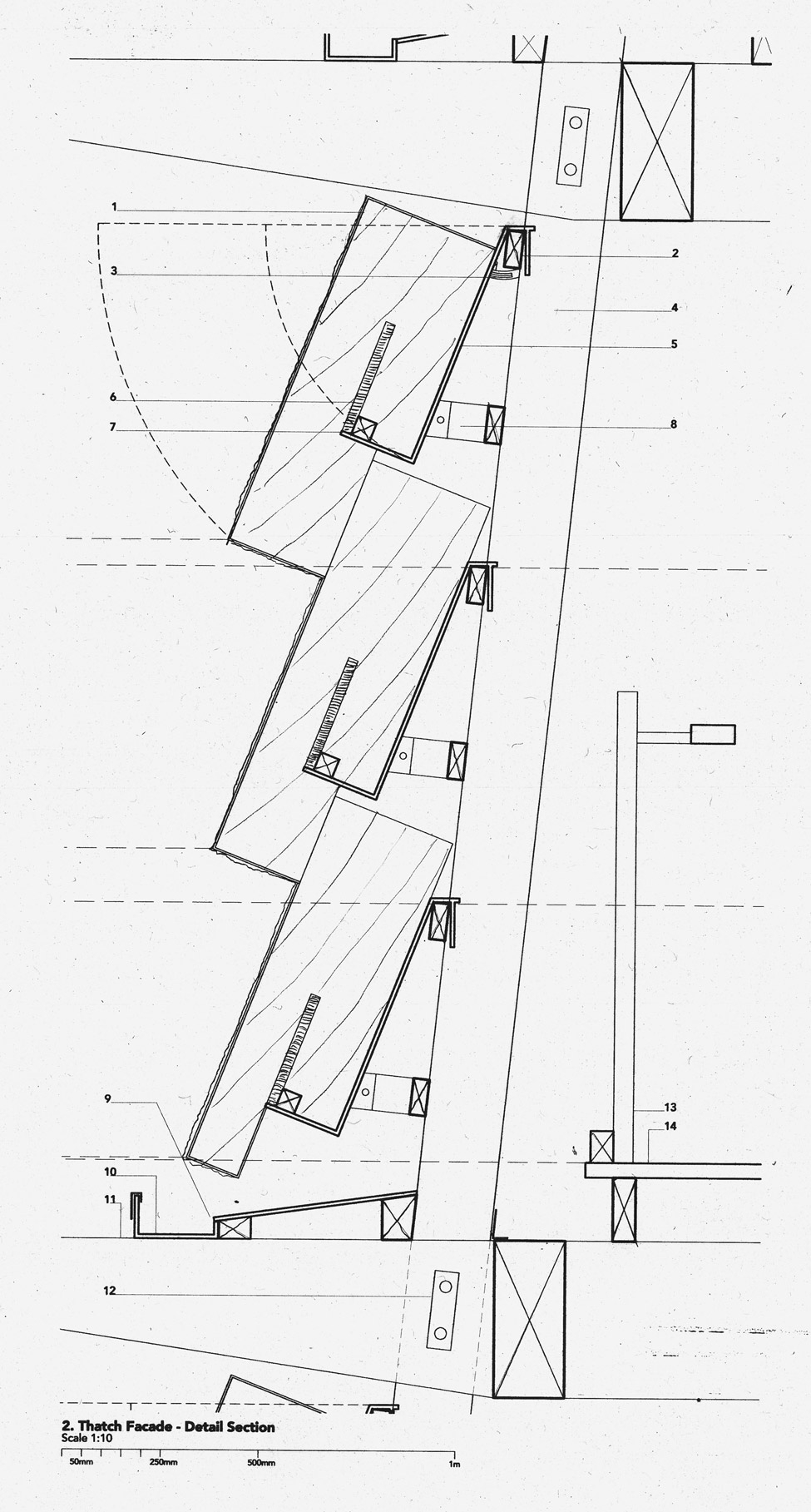
Thatch Windbreak Facade | Detail Section 1:10
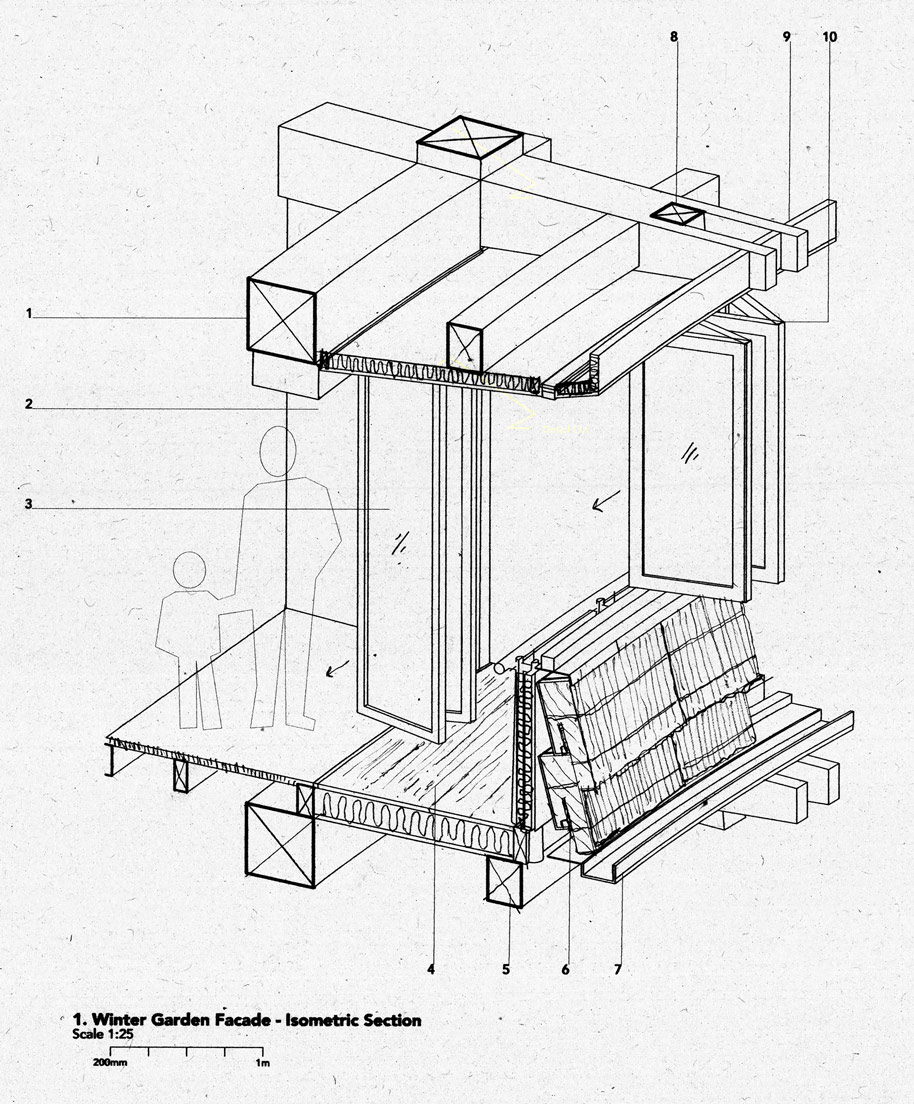
Winter Garden Balcony | Isometric
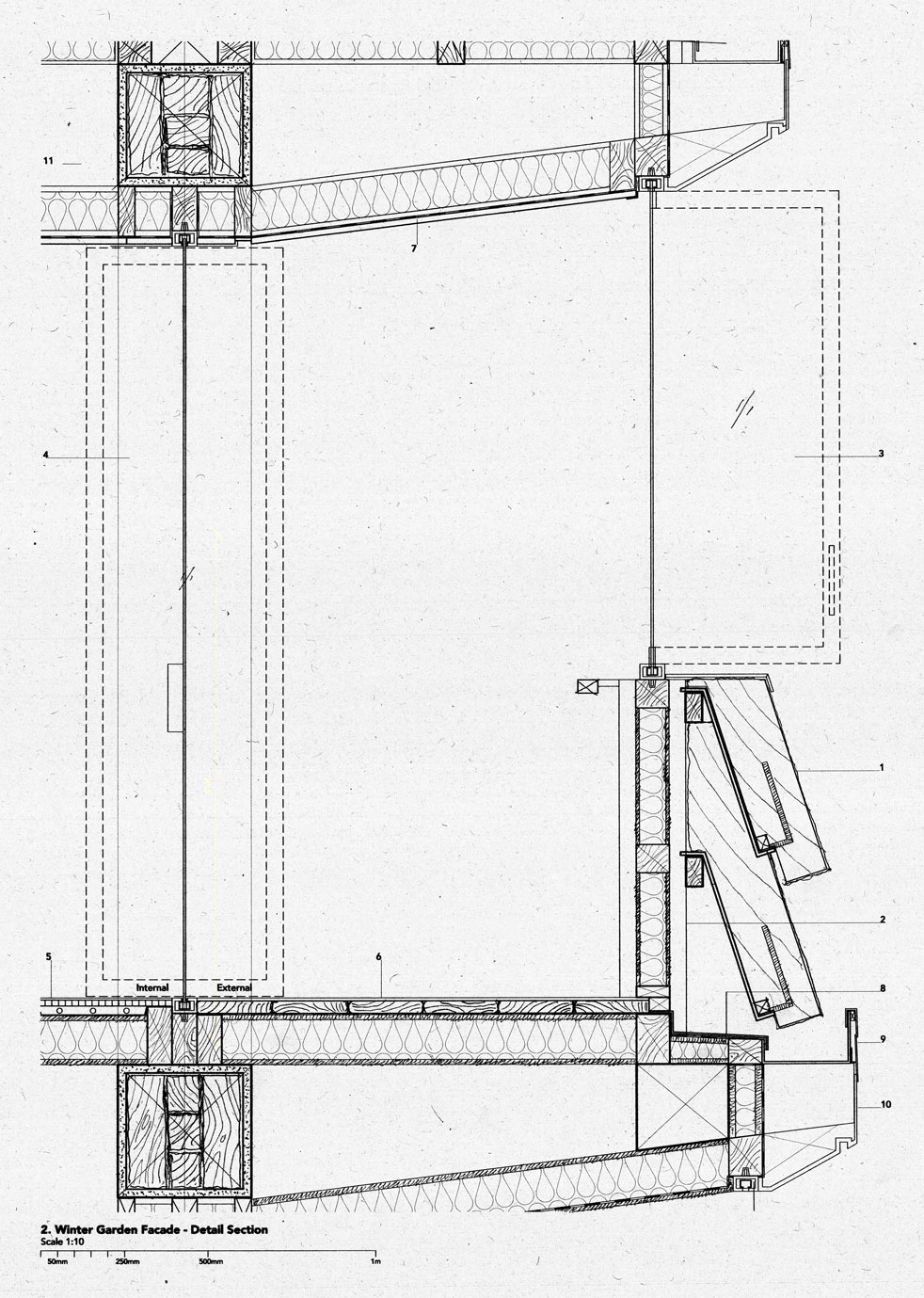
Winter Garden Balcony | Detail Section 1:10
Extractive Temporalities & Vernacular Potentials
Spatialised resource mapping and terrestrial extraction processes embedded within regional building traditions. This mapping examines the relationship between the site scale of Craigleith Quarry, the city of Edinburgh, and proposed housing locations identified in local development plans, situated within the wider Scottish context of regional material availability.
It also investigates past and present sites of material production, including former and active quarries, alongside mapped locations of vernacular earth and thatch construction. These mappings reveal opportunities for future expansion across former production sites, such as abandoned or backfilled quarries, while highlighting the potential to source materials through local and regional supply networks and waste economies.
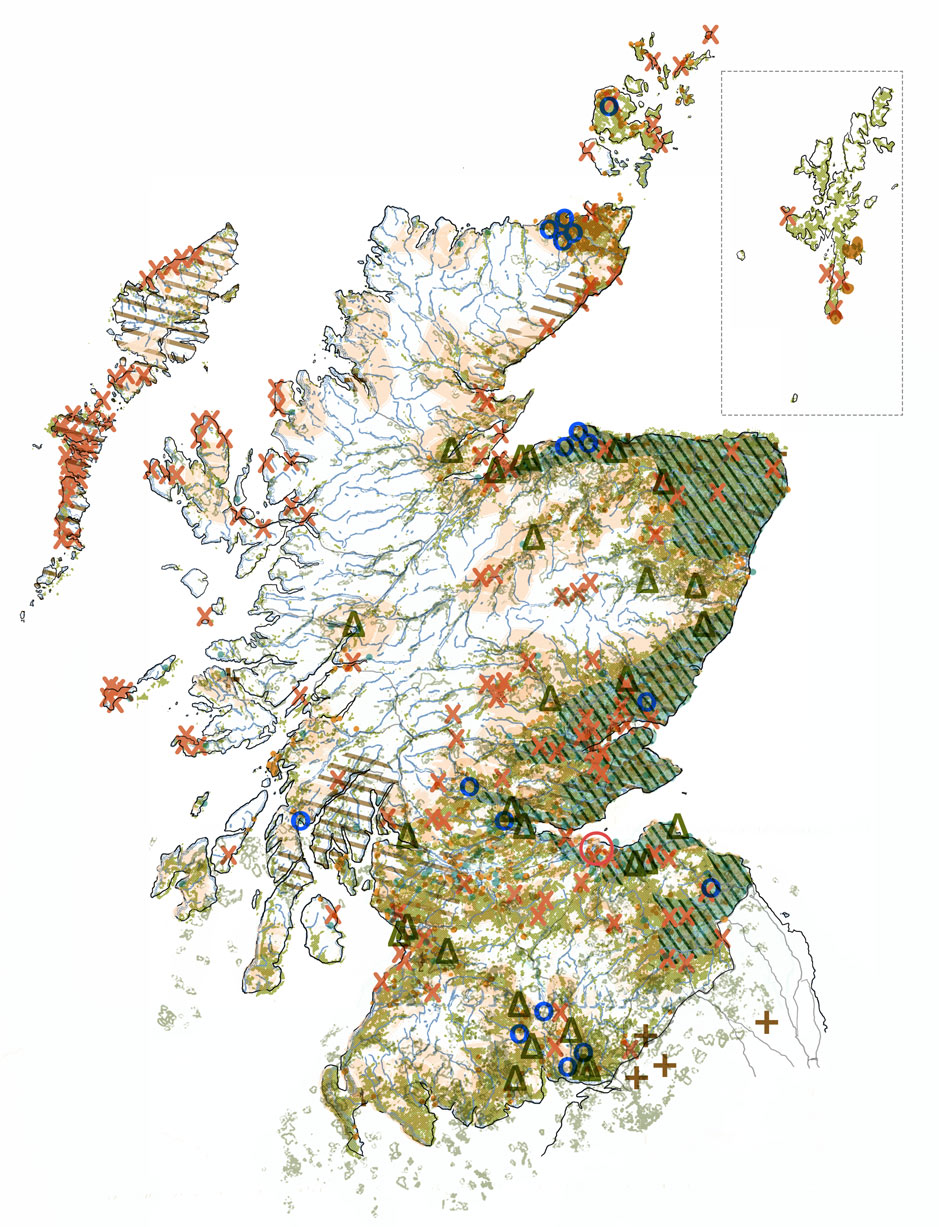
Vernacularity Potentials : Mapping of regional resources availability and past building culture

Building stones, past & active quarries
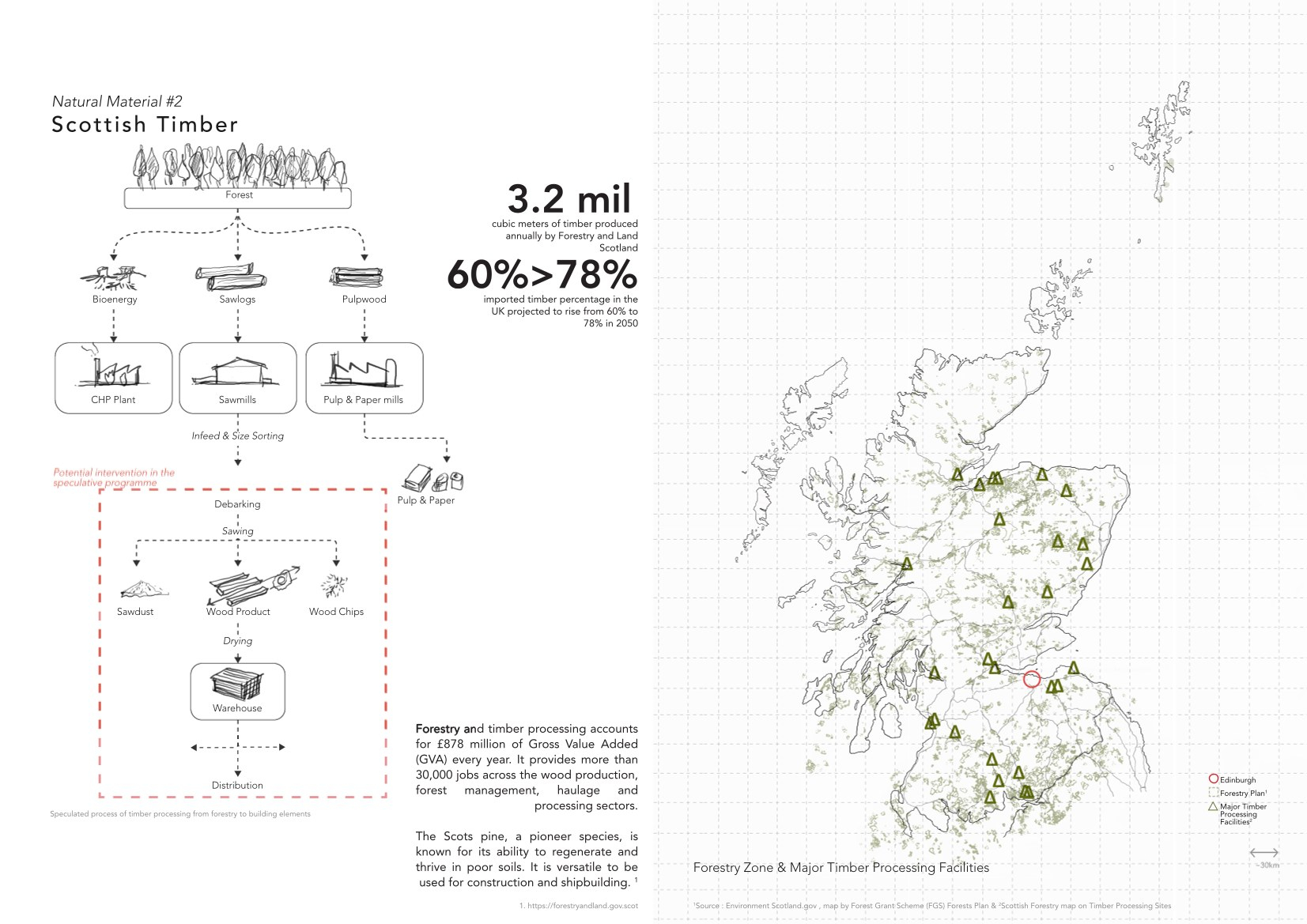
Scottish timber : forestry plan & local timber processing facilities

Earth buildings : regions with earth building remnants

Thatch roof : surveyed thatched buildings, grass coverage, river marshes & winter wheat crops
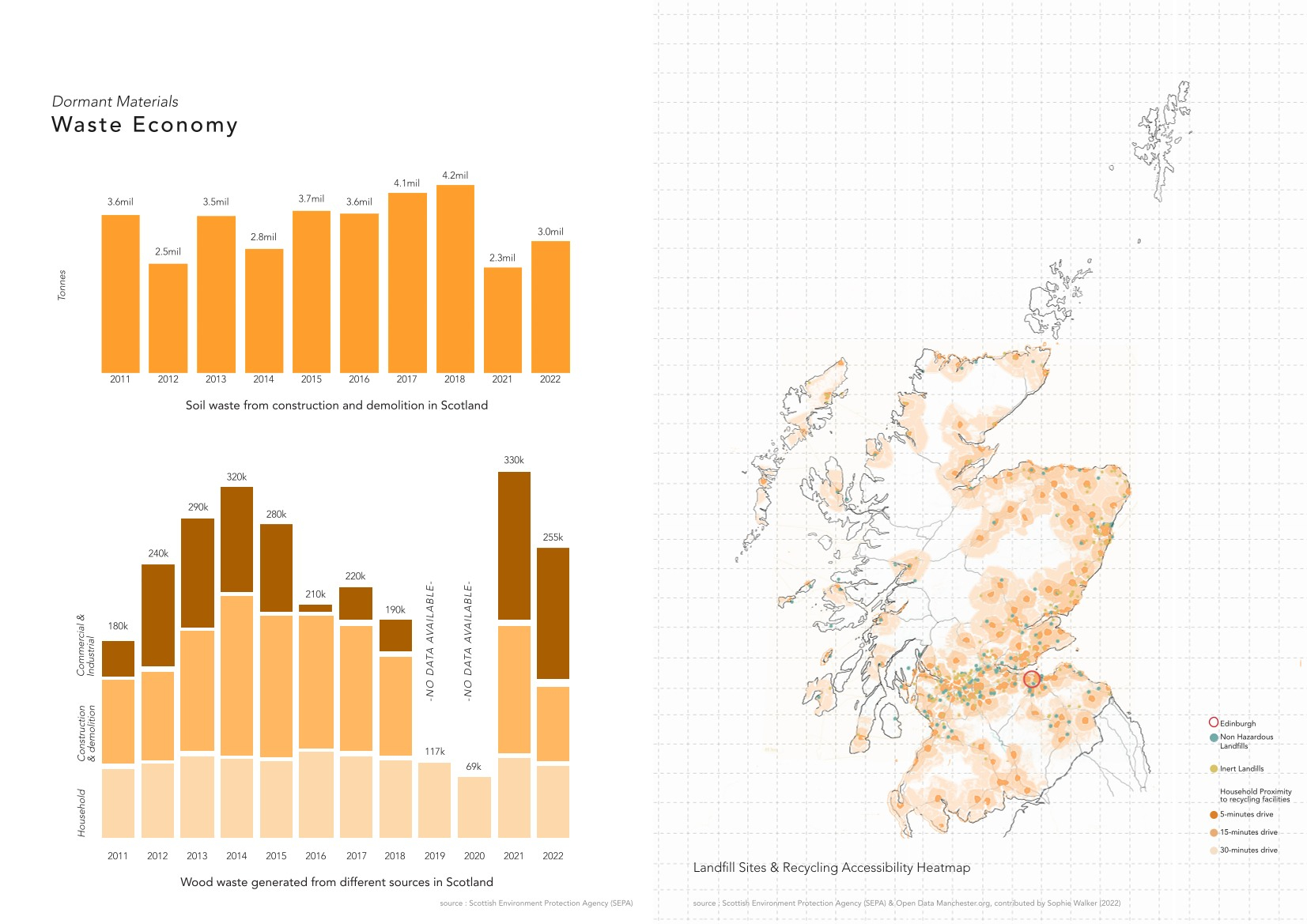
Waste economy : construction waste, landfill sites & recycling accessibility heatmap
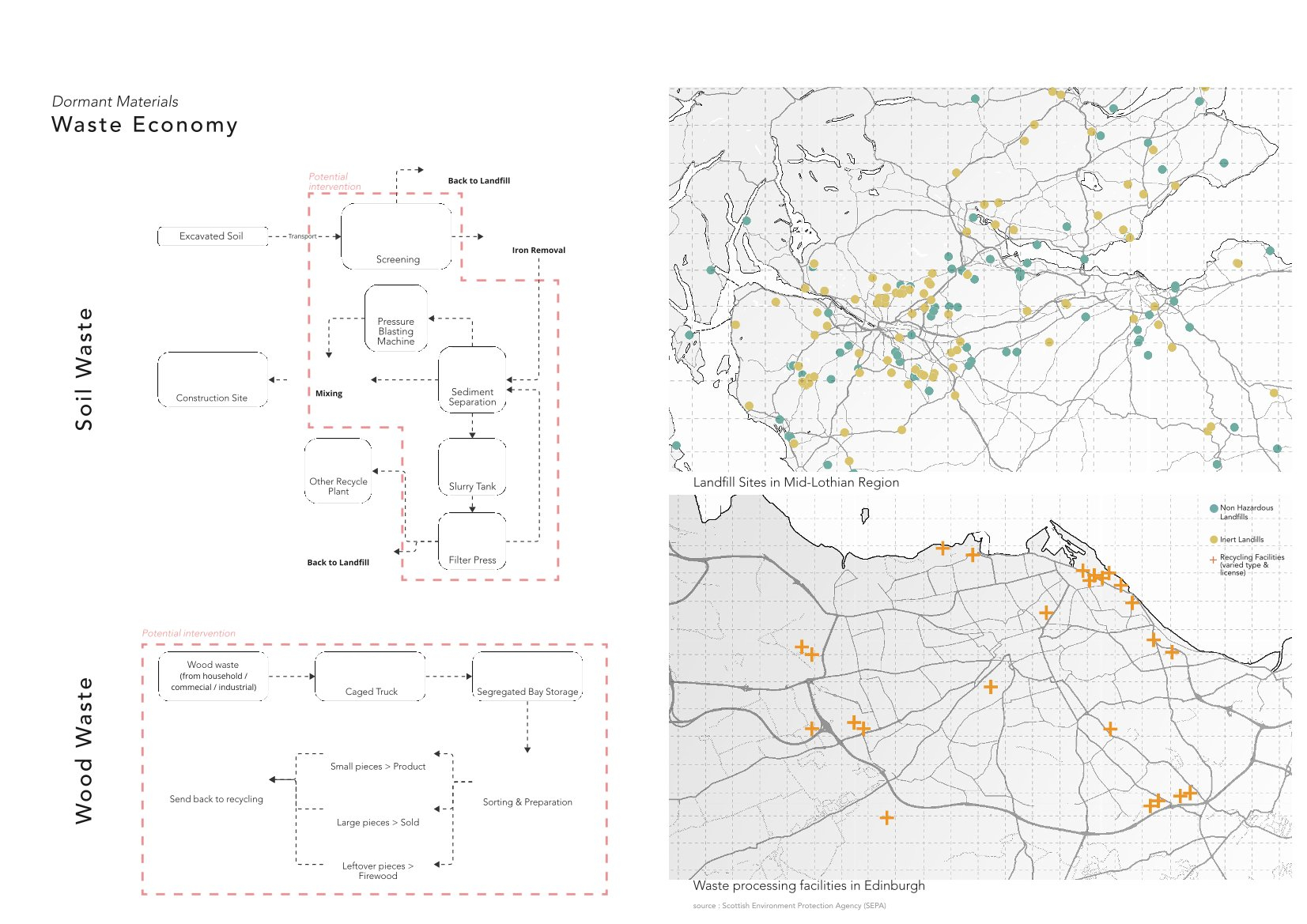
Waste economy : regional landfill sites & waste processing facilities
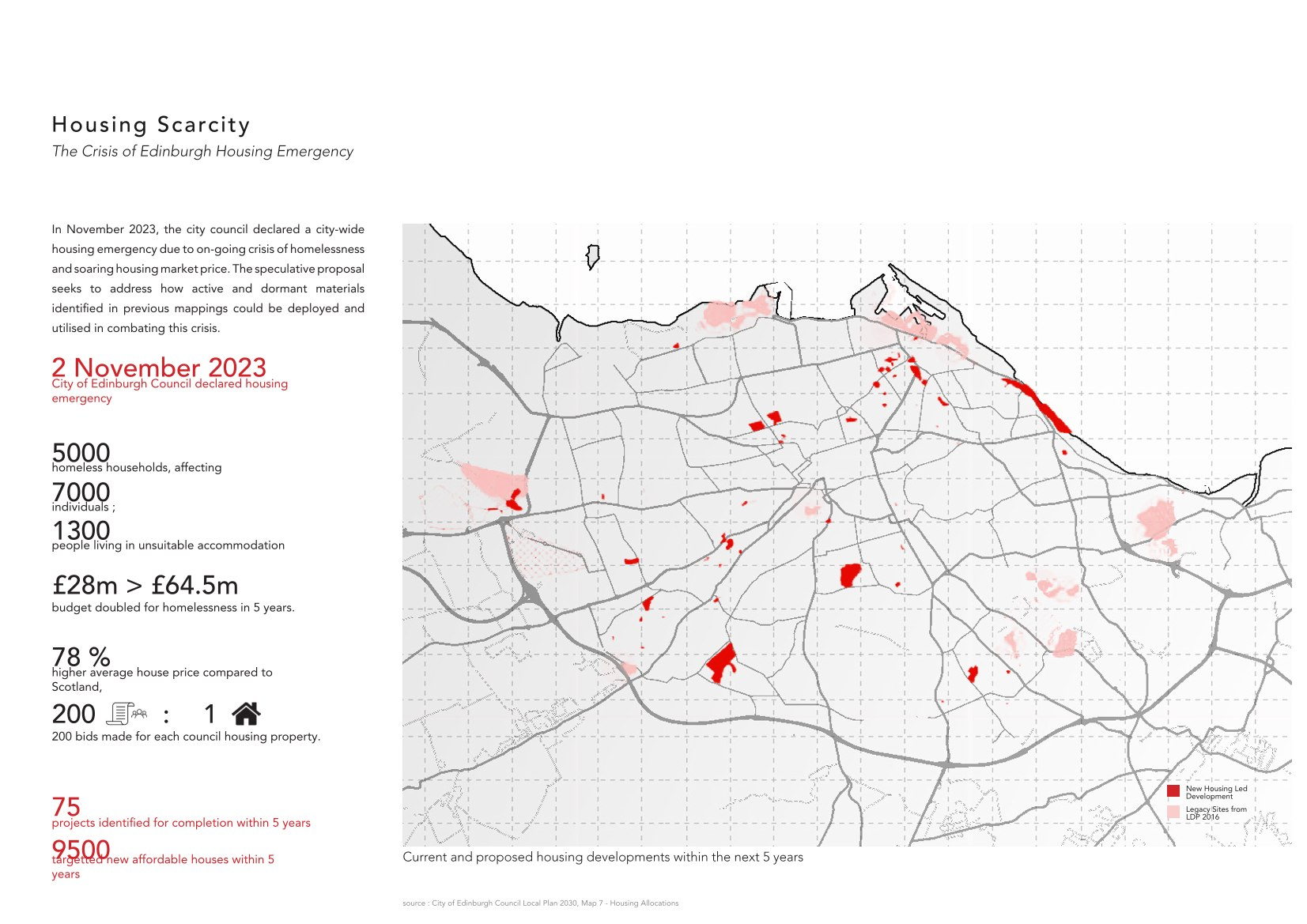
Housing emergency mapping : legacy housing sites and future developments
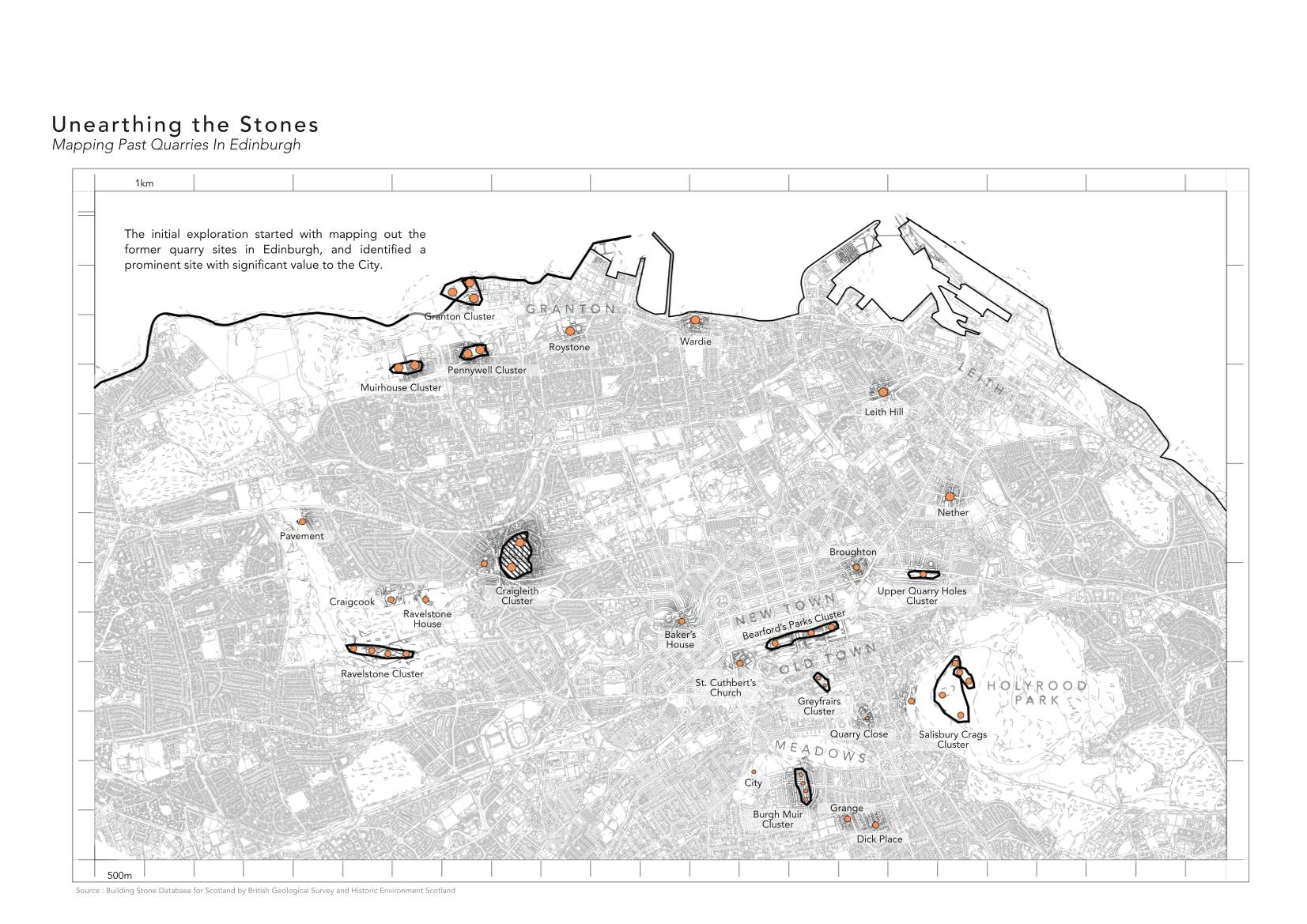
Extractive Legacy : Past quarry sites in Edinburgh

Extractive Legacy : Craigleith stone traces
Builder's Yard : Projecting the cycle of production
Embedding multiple space-use programme based on cyclical harvest, collective production and inhabitation. The Builder’s Yard contains pattern language and tectonic kernel that will be replicated to the immediate neighbourhood.
The builders’ yard becomes the home base for architect-builders, a place to test ideas, iteration and involve the community directly in the act of building. It contains the capacity to produce locally harvested materials, manufacturing building components, and becoming a nucleus for the neighbourhood growth.
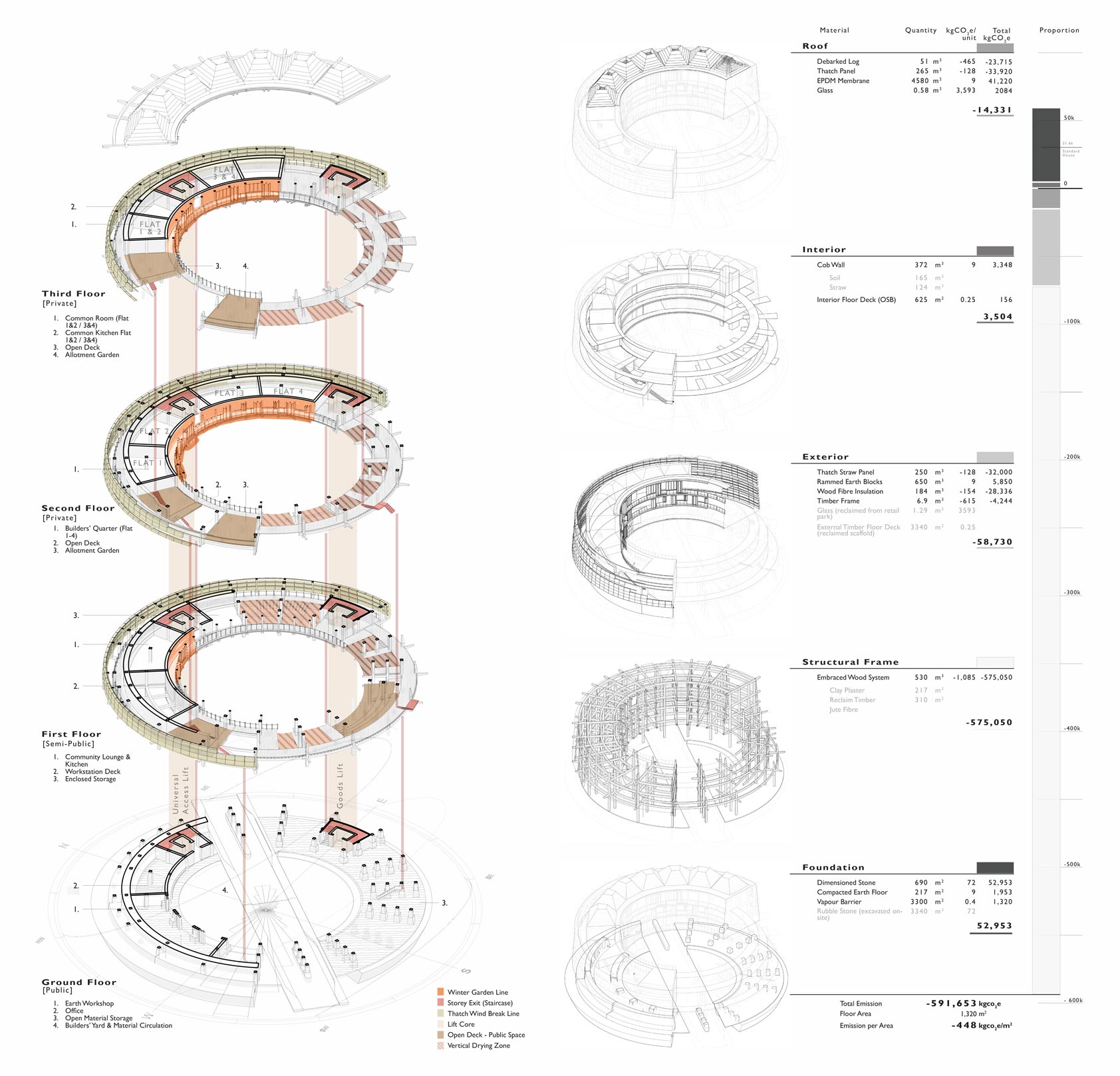
Builder's Yard : Climatic adaptation & embodied carbon estimation
Builder's Yard : Centralised Yard, Decentralised Practices
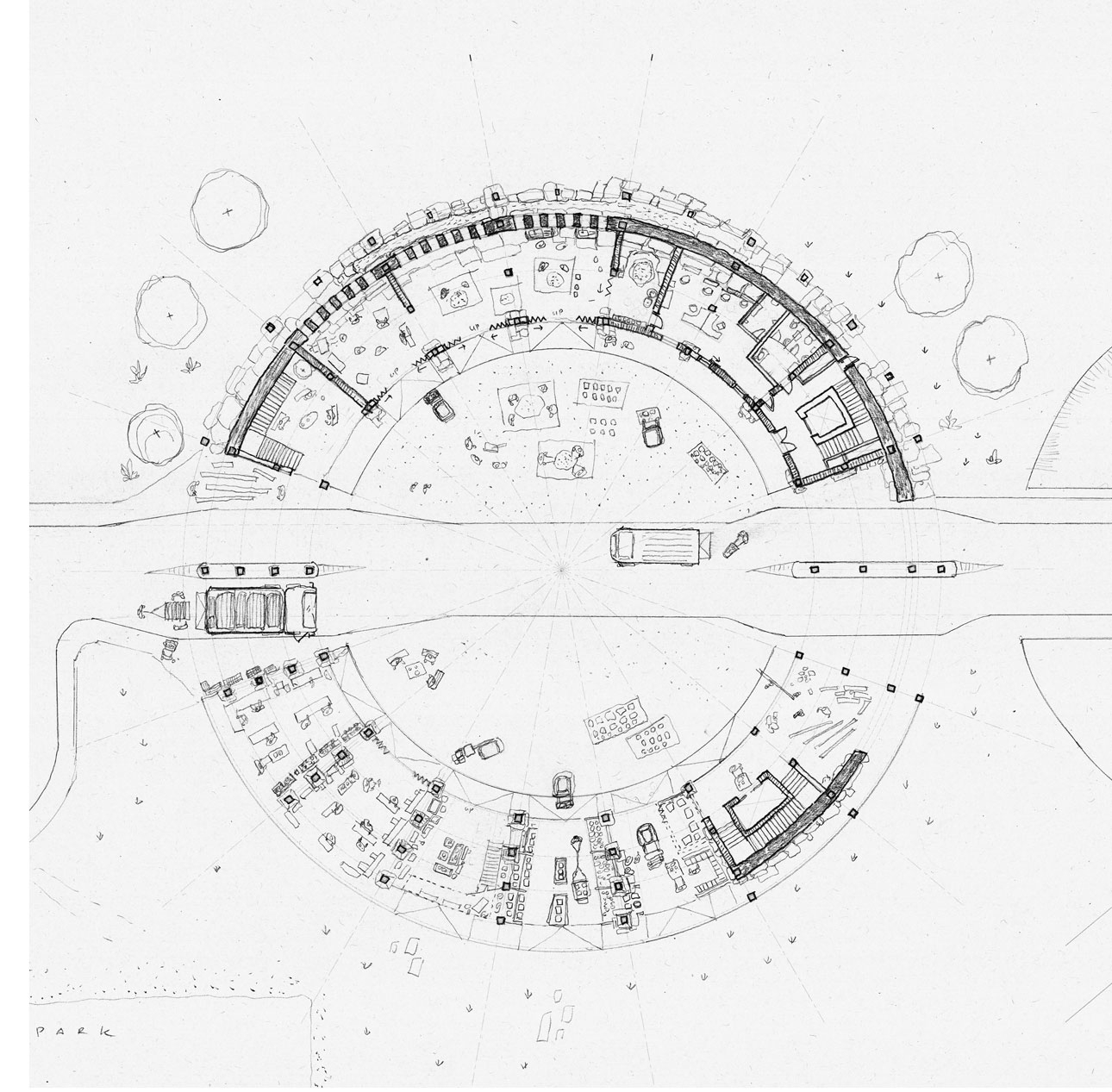
Ground Floor : Workshop, Open Storage & Open Yard
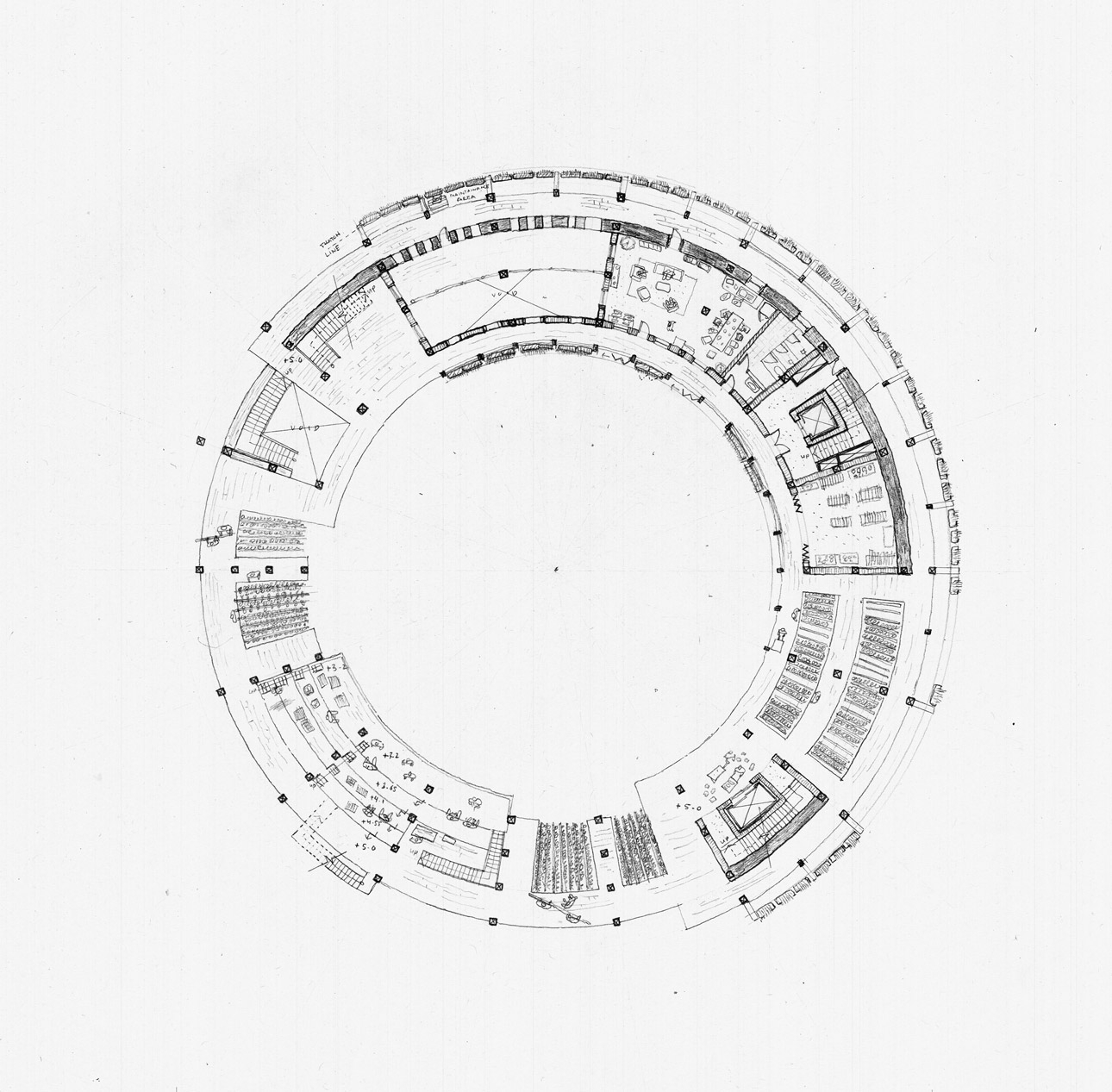
First Floor : Community Space, Amphitheater, Drying Rack
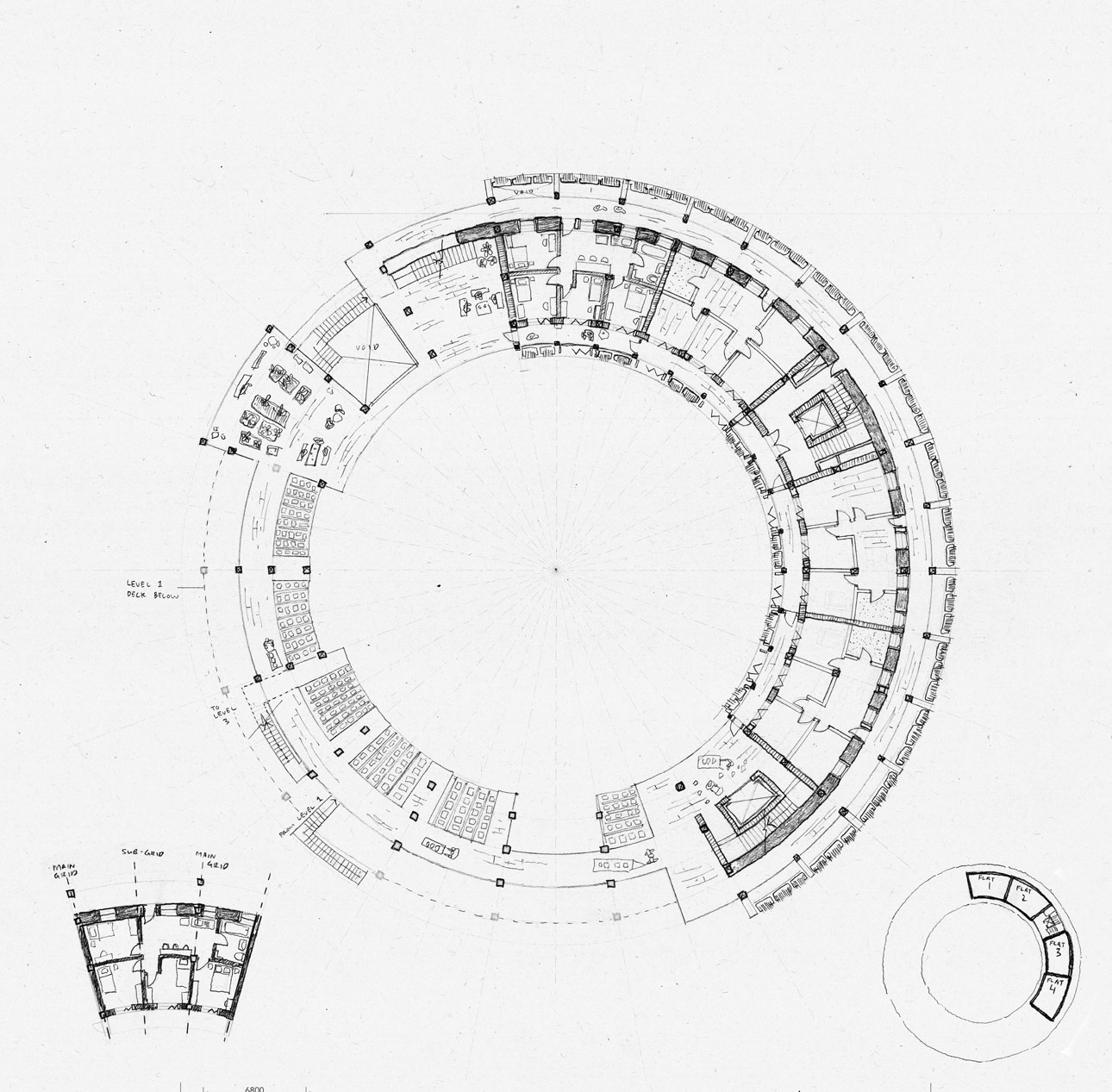
Second Floor : Builders' Quarters, Open Staircase & Allotment, Drying Rack
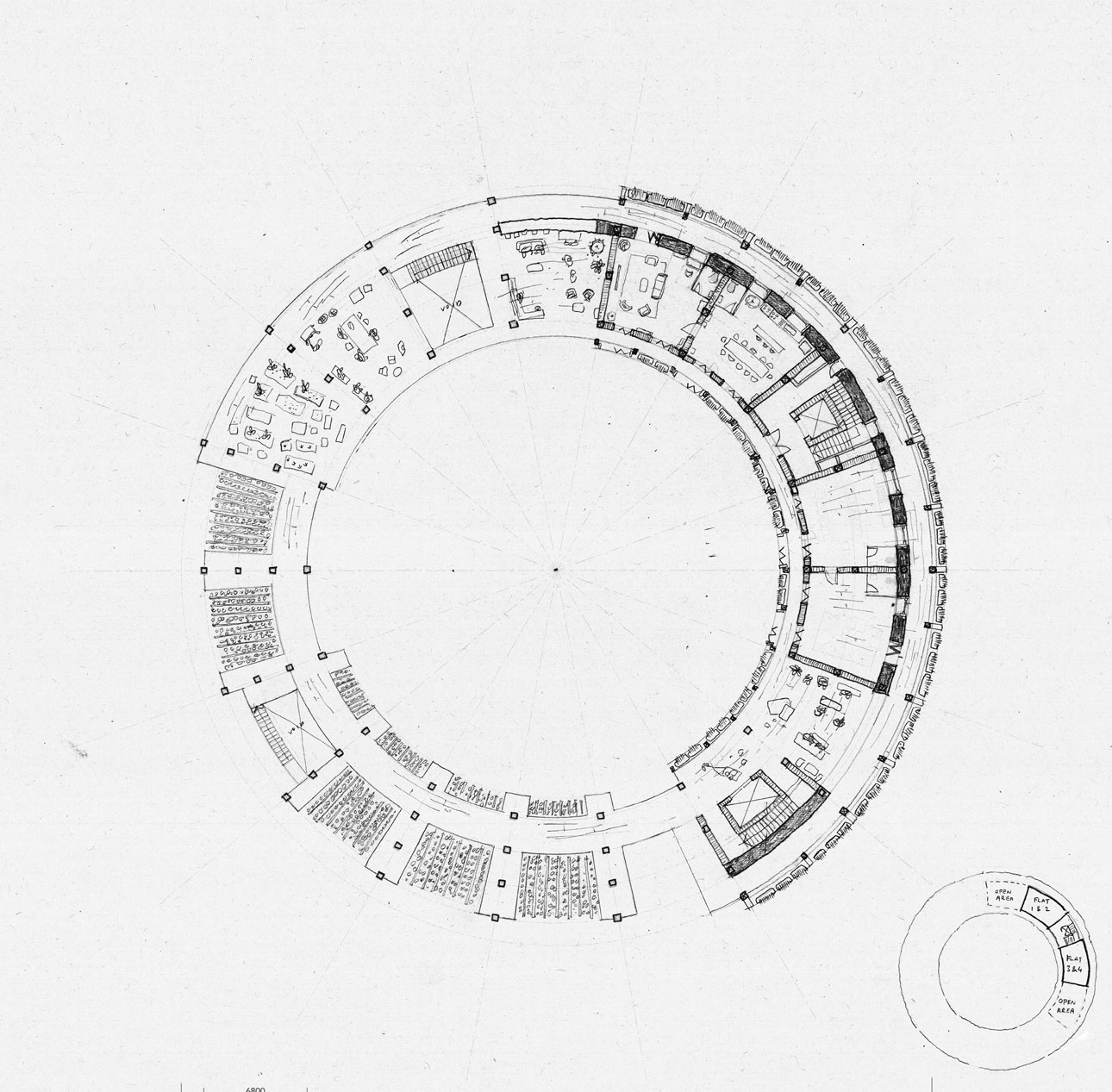
Third Floor : Builders' Common Room, Communal Kitchen, Drying Rack
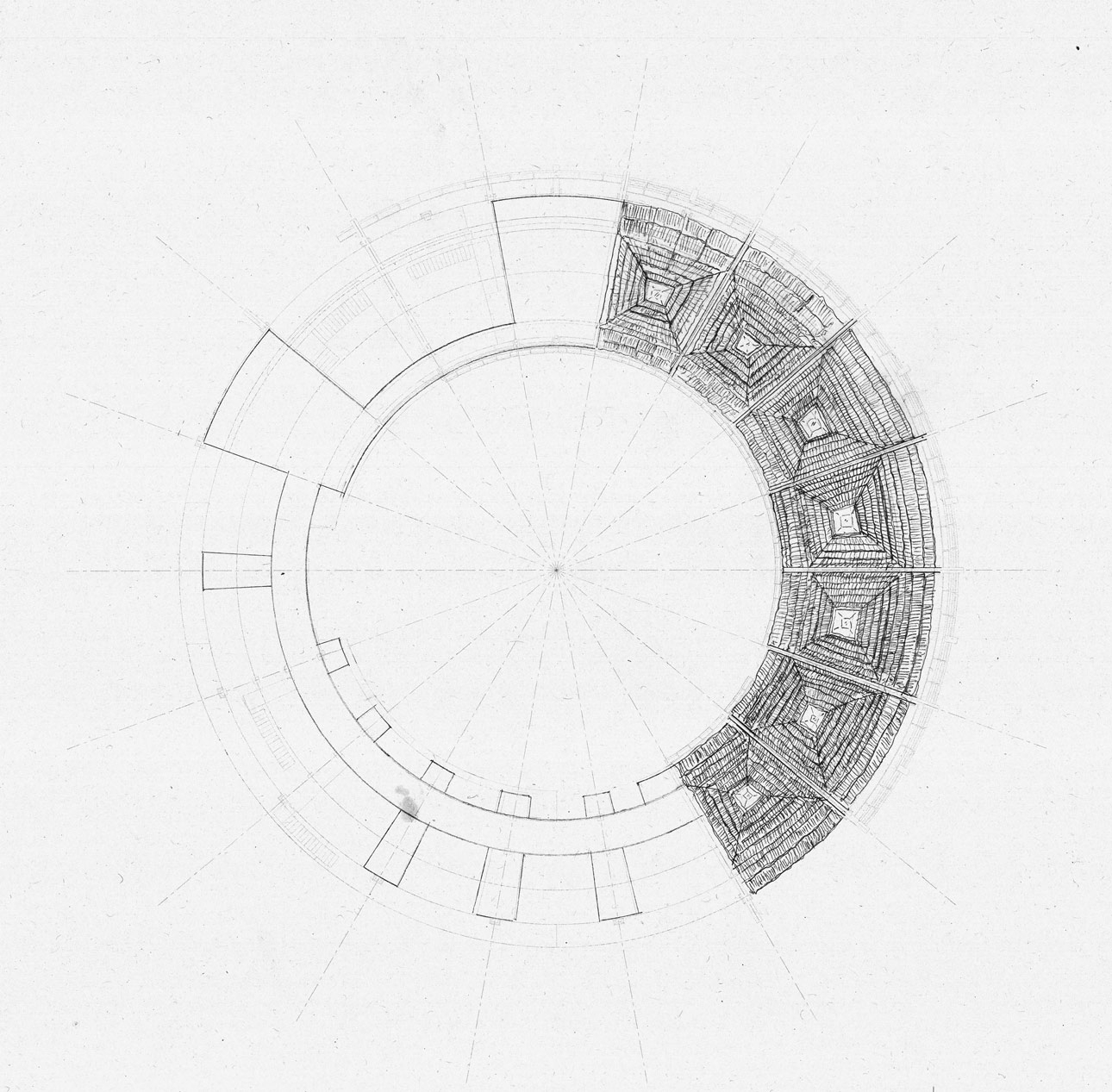
Roof Plan : Reciprocal Thatch Roof
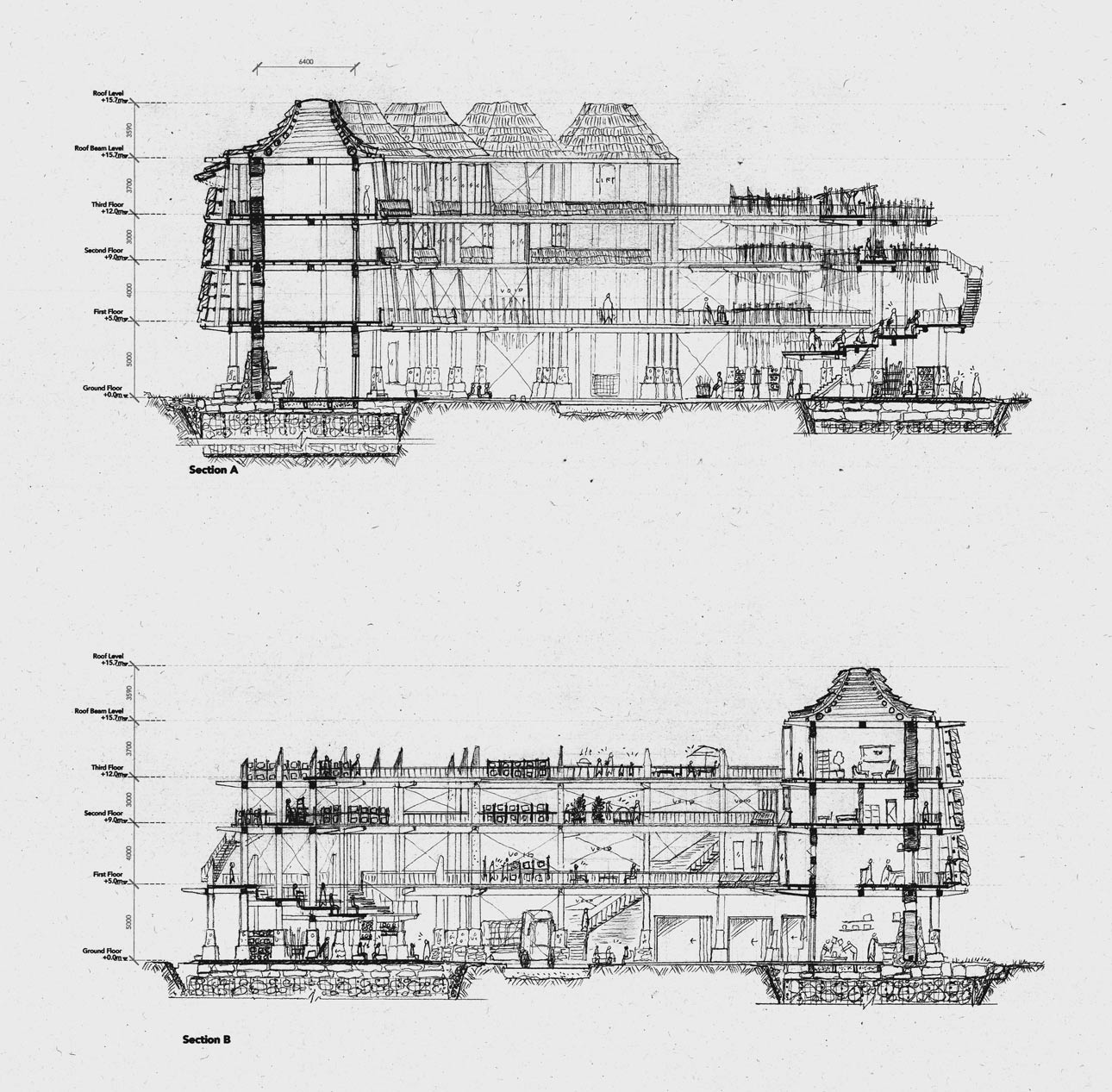
Building Section
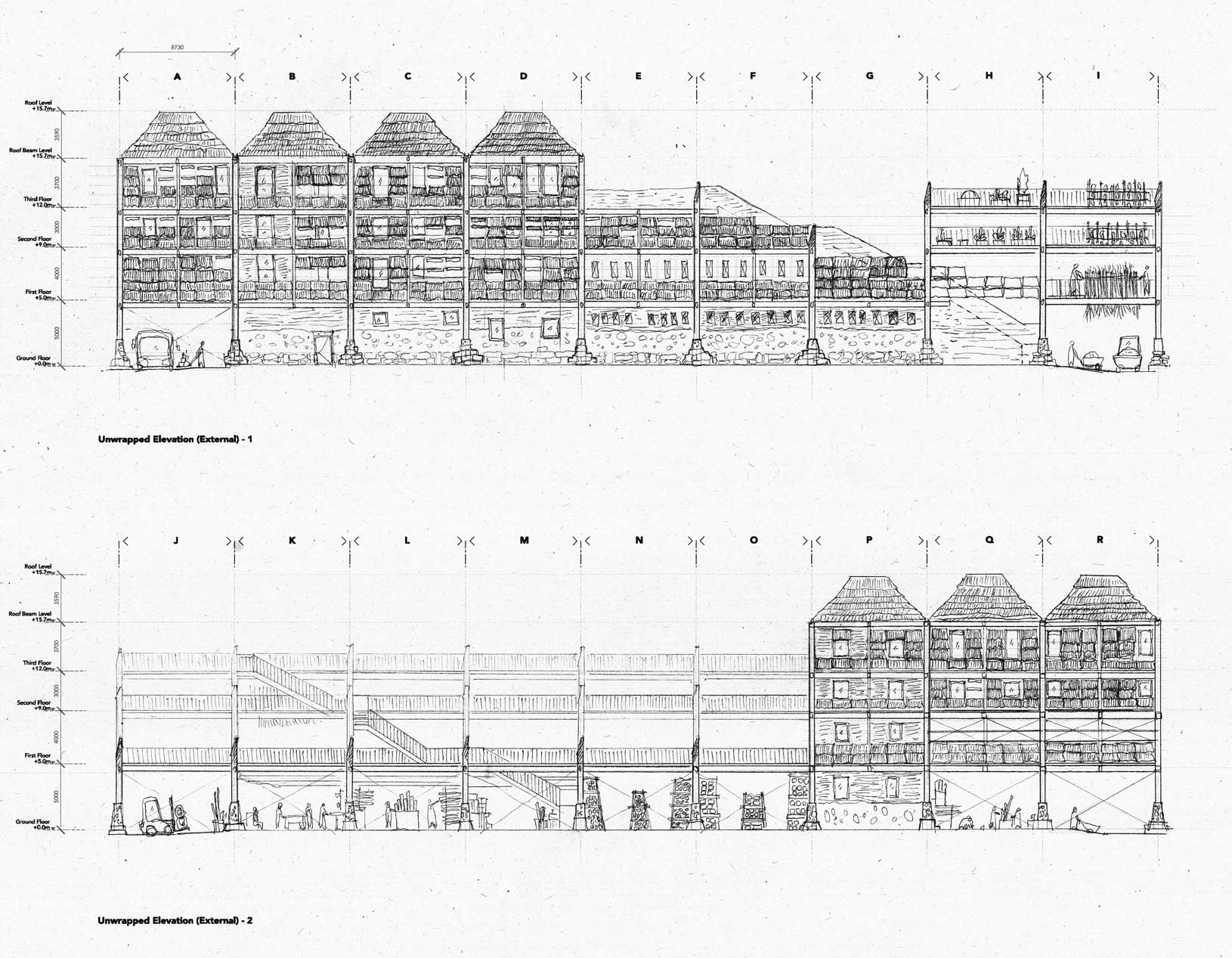
Unfolded External Elevation
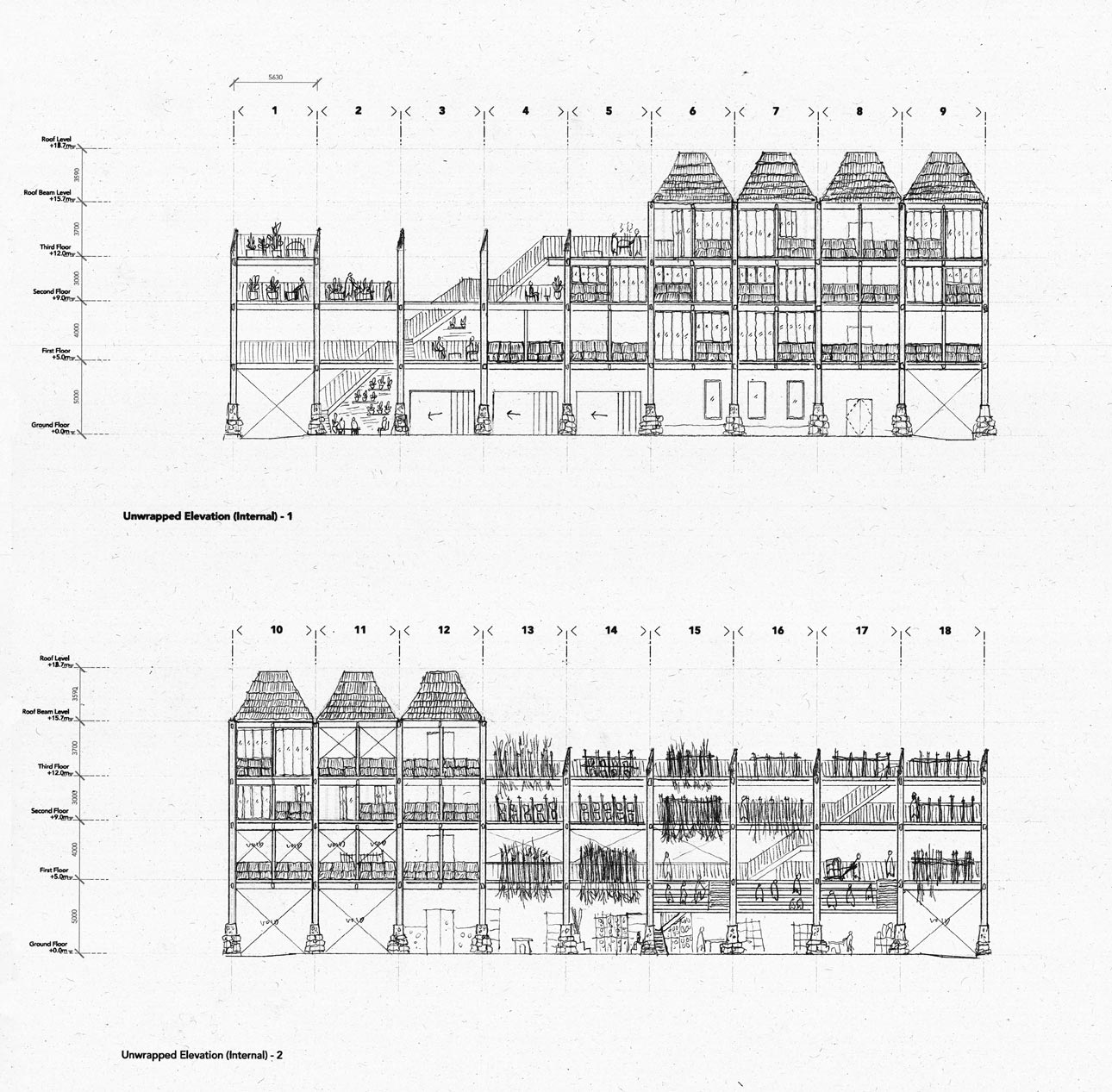
Unfolded Internal Elevation
Doirneag : Live-Build Project at Lauriston Farm (Year 1)
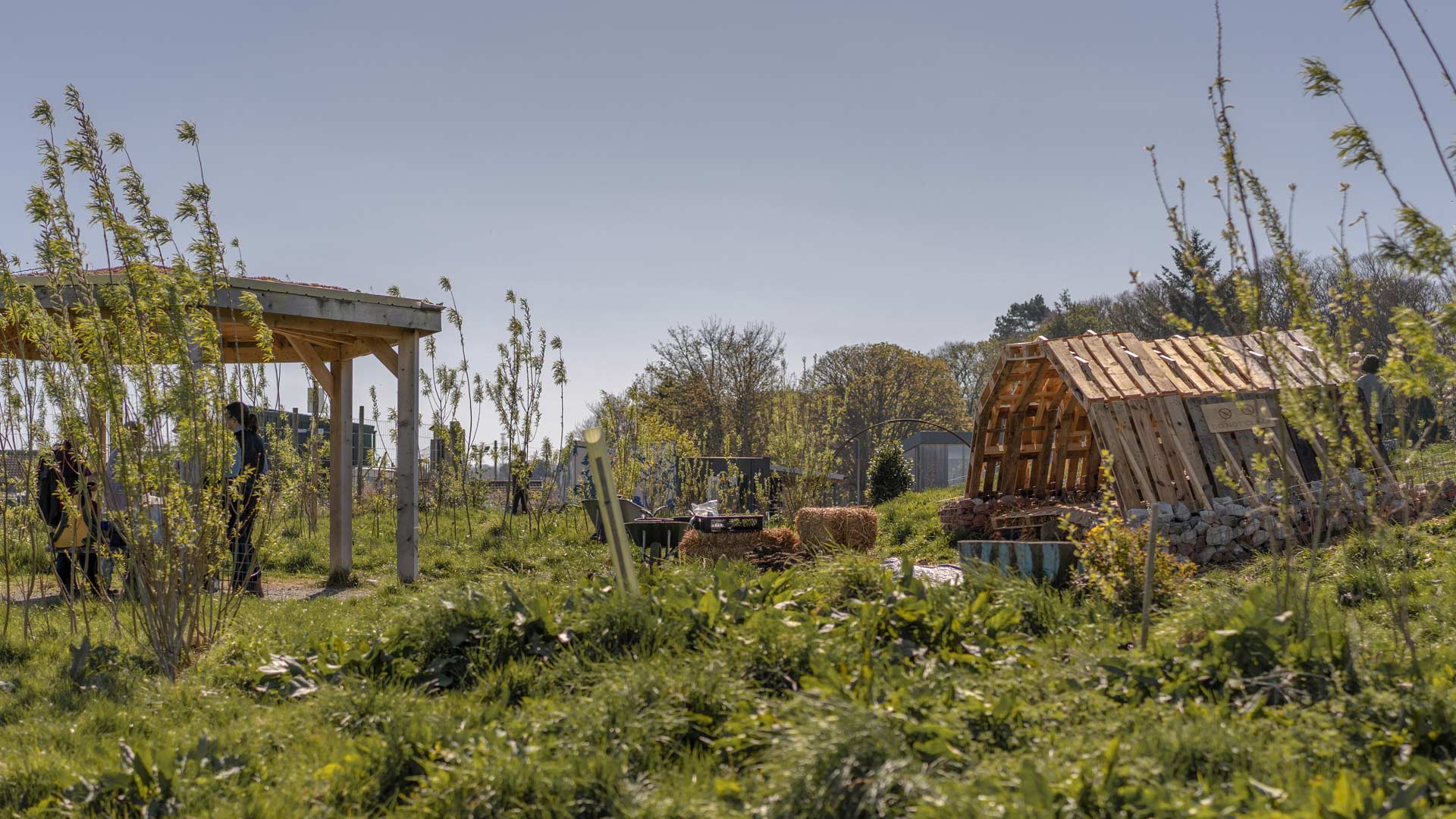
Doirneag : seating structure pavilion overlooking existing pergoda at Lauriston Farm
Collective Production
Growing, harvesting, congregation, regeneration, community and biodiversity. The complex circuitry of Lauriston Community Farm following Aldo Leopold's definition of land as a fountain of energy flowing through a circuit of soils, plants, and animals, was carefully mapped through the direct participation in weekly volunteering sessions, allowing our designs to organically emerge from shared labour, understanding,solidarity, and participation.
The farm provides shared plots, skills and knowledge to diverse groups, regularly distributing resources and holding community events. This, and their ethos of no-dig farming, in addition to the sustainable sourcing and reuse of available materials, permeates each individual allotment and inspired our live-build design.
The structure is situated on the Mound, and provides seating and a roof that, in conjunction with the existing Pagoda, offers opportunities for teaching, socialisation and events, both formal and not. Sitting above a slope are gabion walls and tyre benches resting at a slant, filled with materials that level their top surfaces. The canopy, a reciprocal structure, lifts pallets overhead in three arches providing shelter whilst remaining permeable to the strong prevalent winds. Local clay covers the seating in a cob mixture, and multiple dorodango (Japanese shiny mud dumplings) made with community stakeholders are located throughout the entire structure. Willows are planted along the perimeter, and will grow to replace the pallet arches after their eventual degradation.
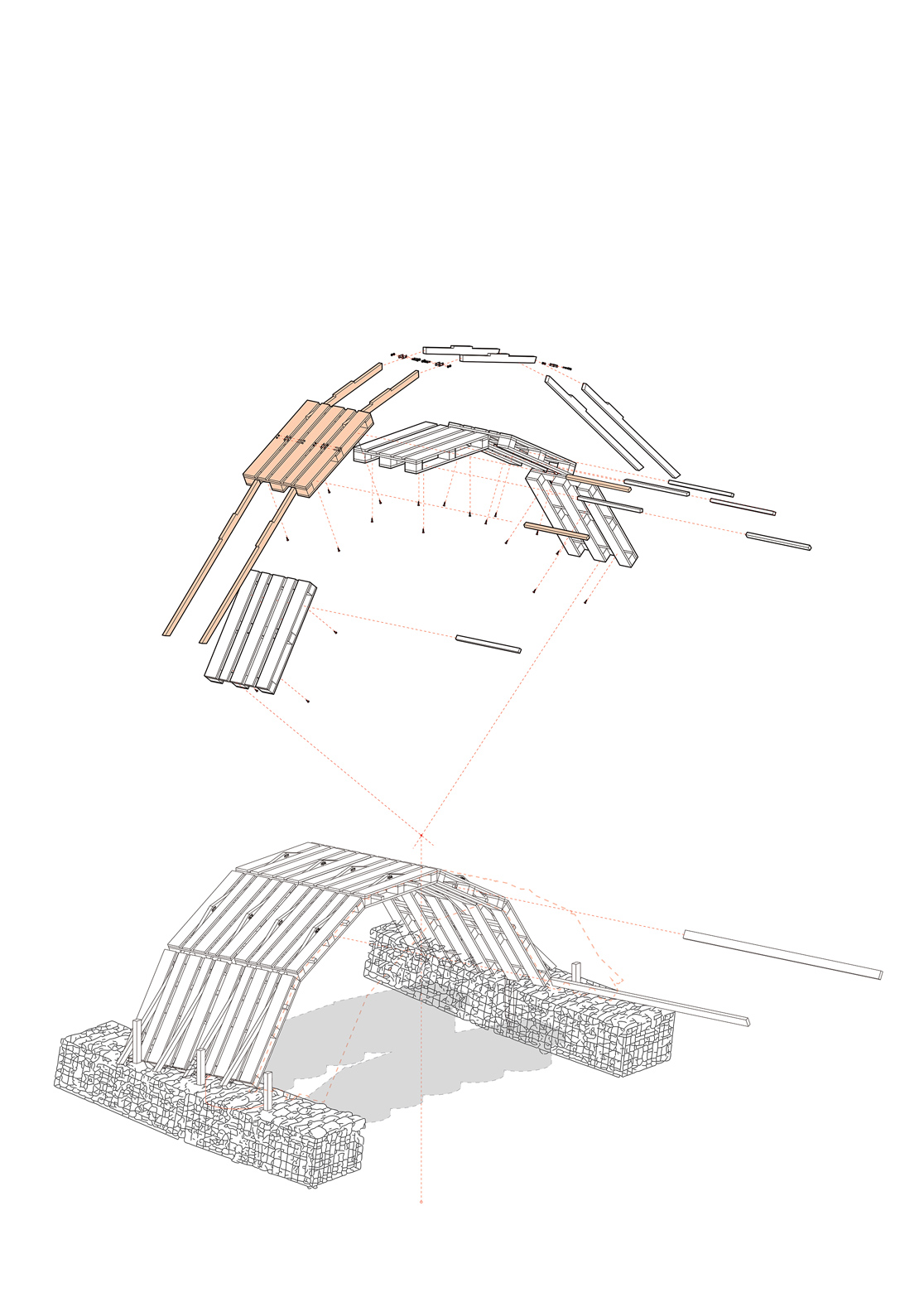
Reciprocal structure components
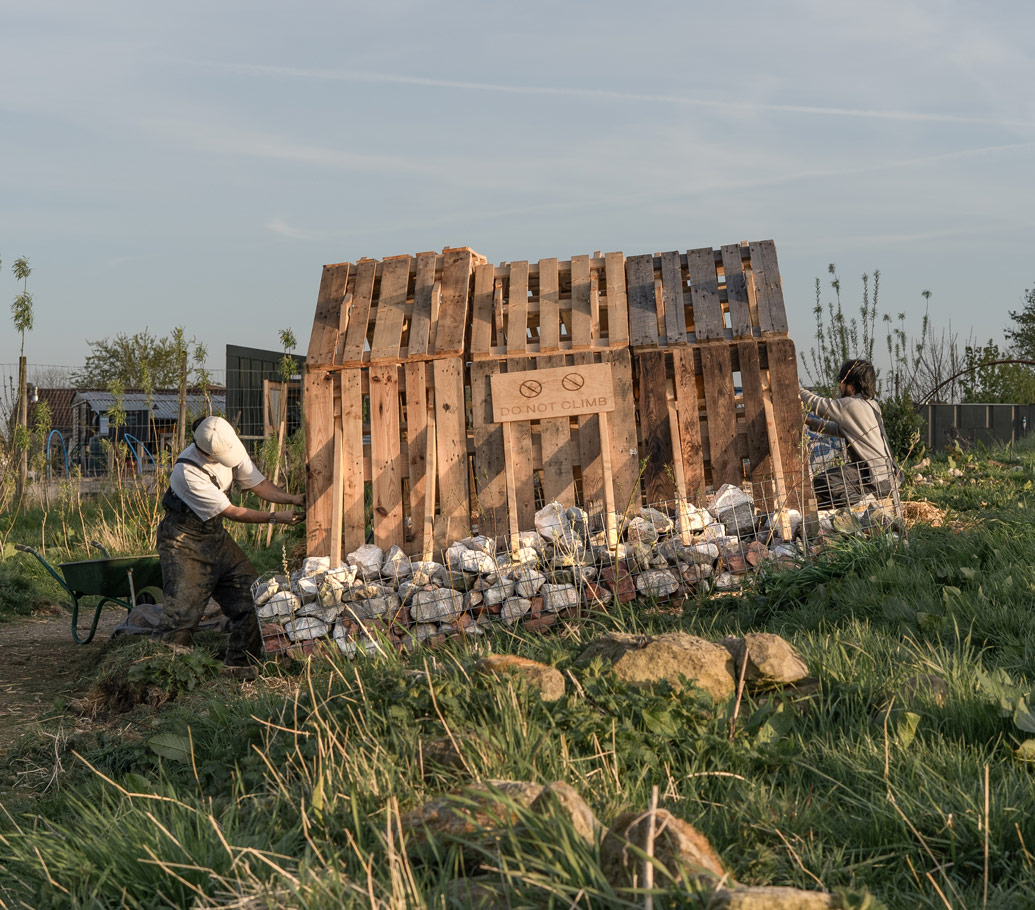
Live-build construction works
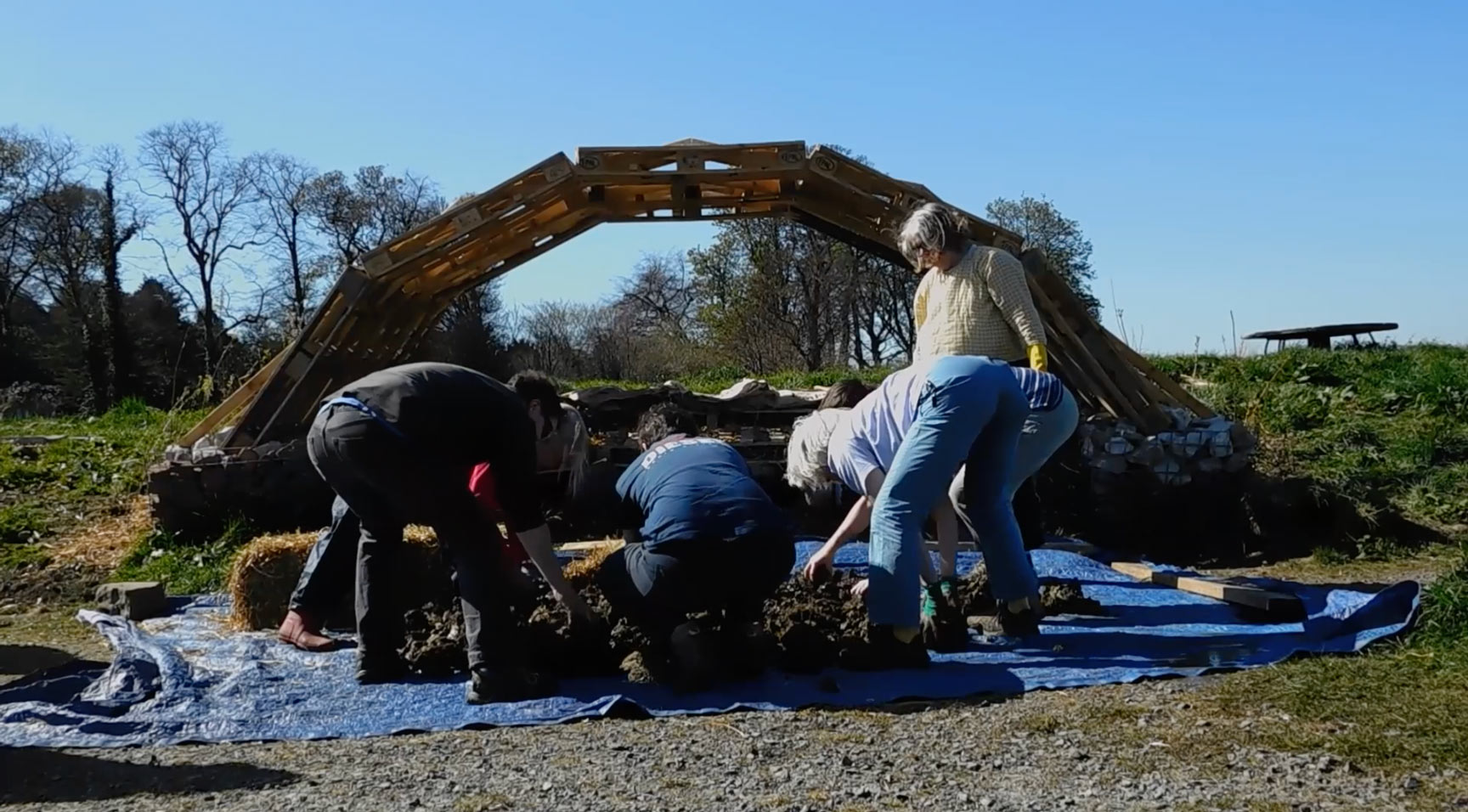
Cobbing workshop with farm volunteers
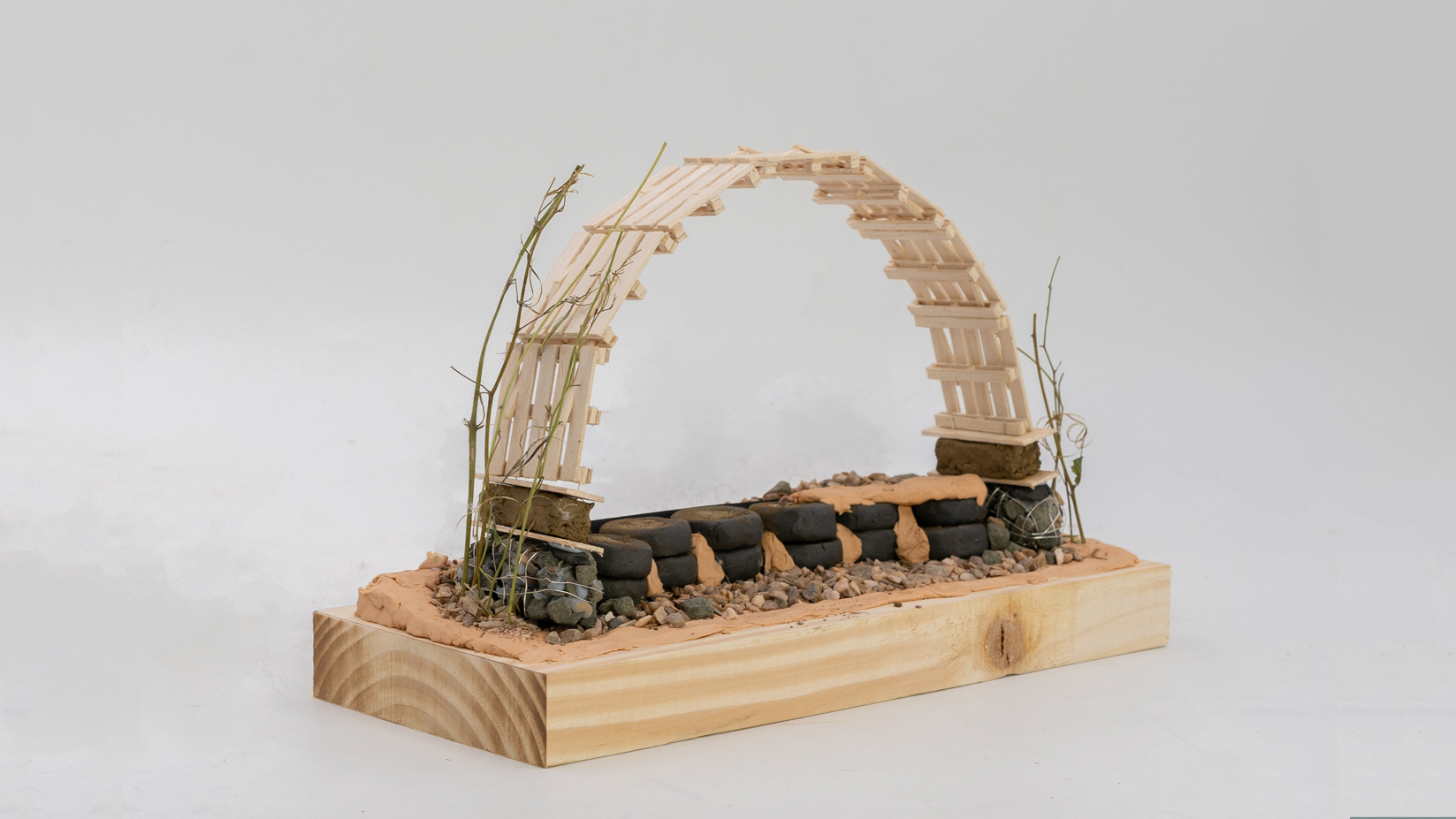
Reciprocal structure scale model
Cobbing workshop with farm volunteers
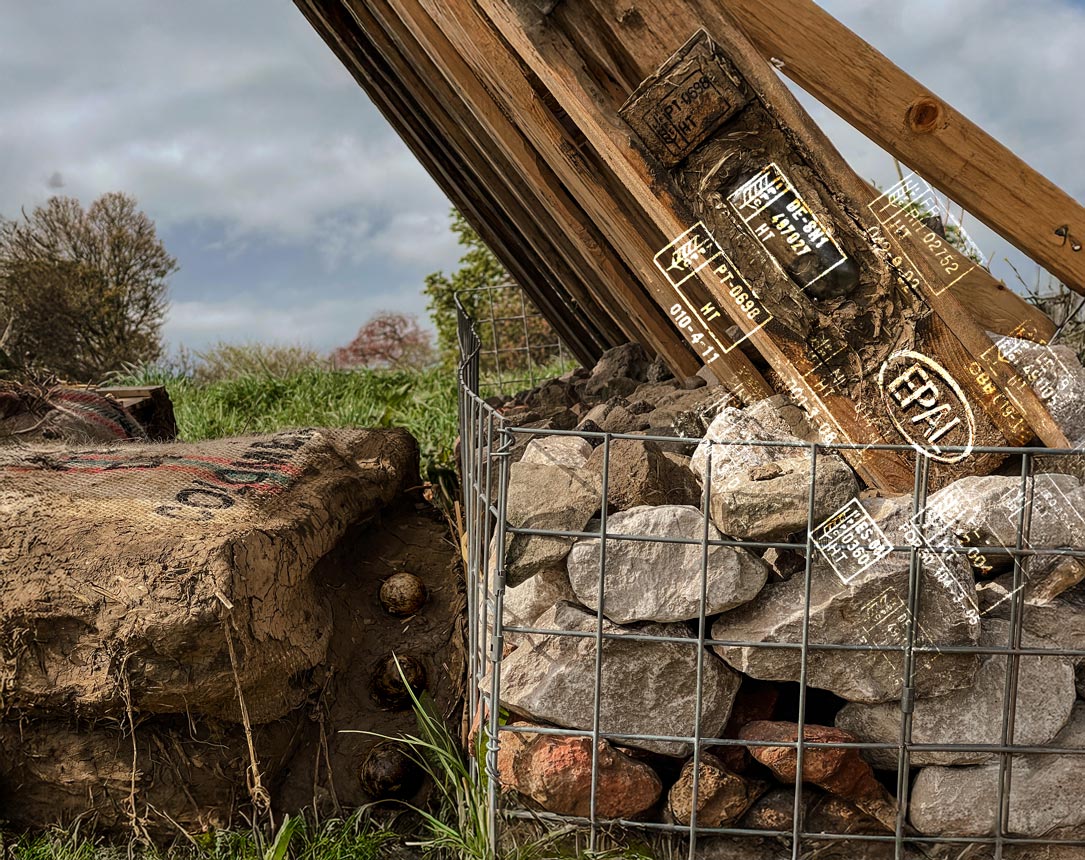
Close up of pallet reciprocal structure, gabion base and cobbed-tire seating
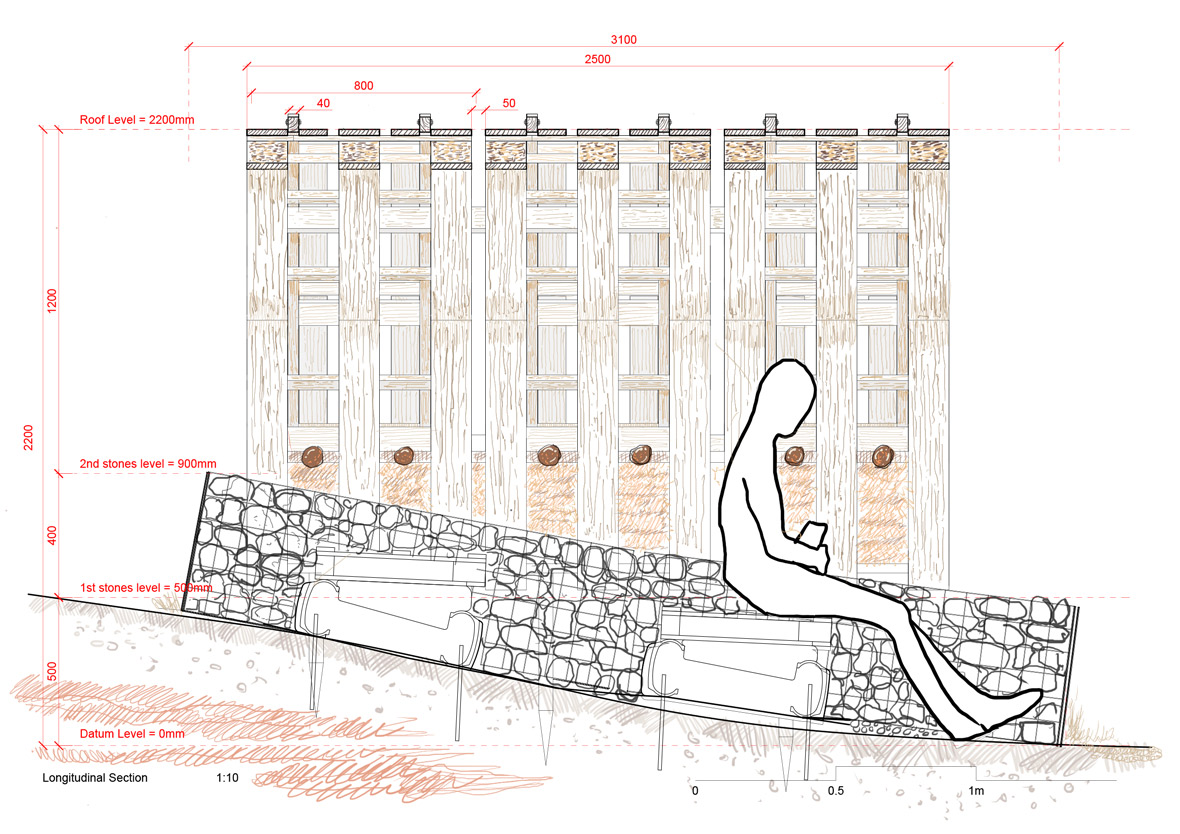
Reciprocal structure detail section
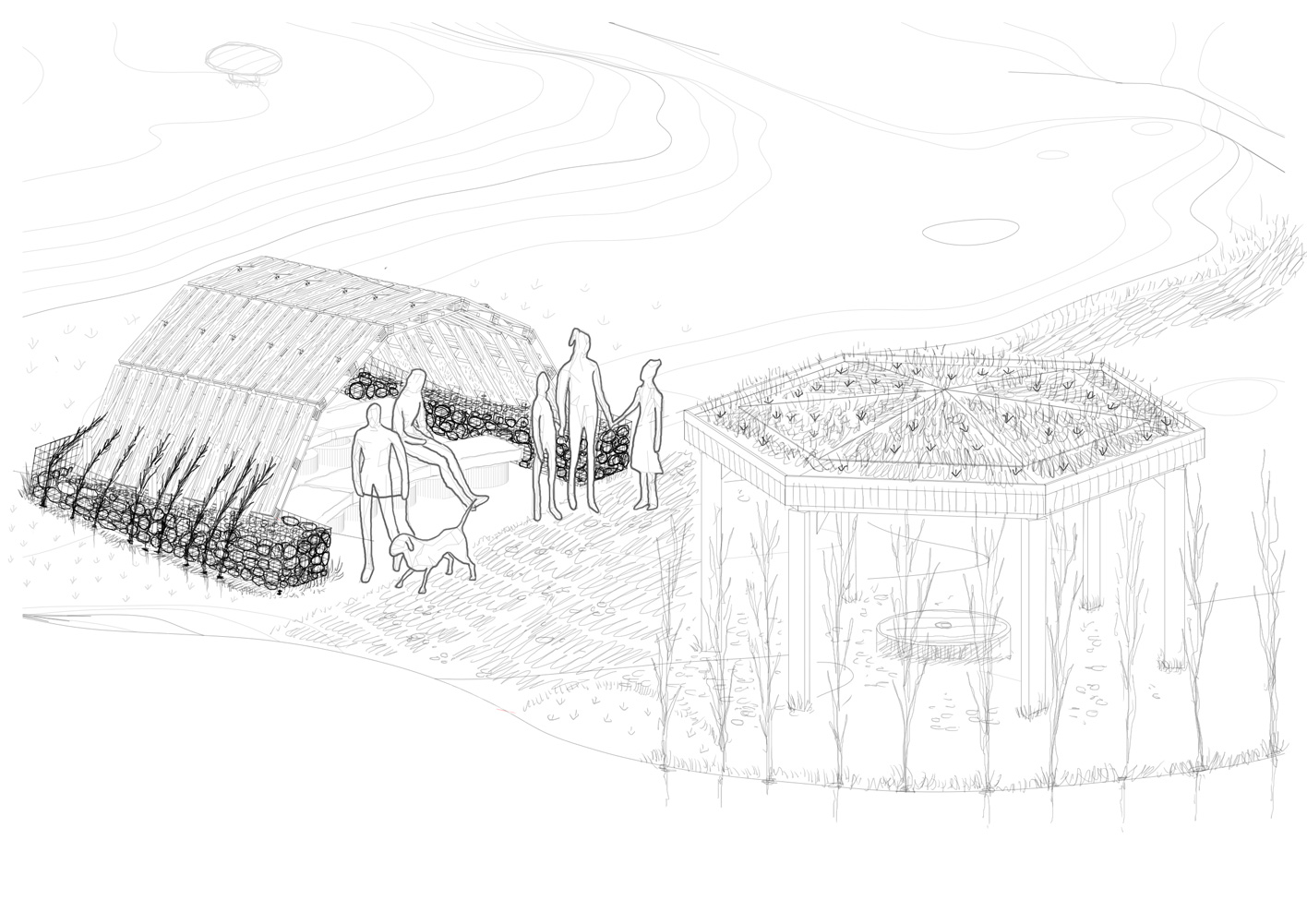
Doirneag : seating structure pavilion overlooking existing pergoda at Lauriston Farm
Hazwan Husain
A Quarry's Almanac : System of Production in Post-Consumption Edinburgh
Follow:
Share: