Proposed 30th-Year Bird's-eye View:
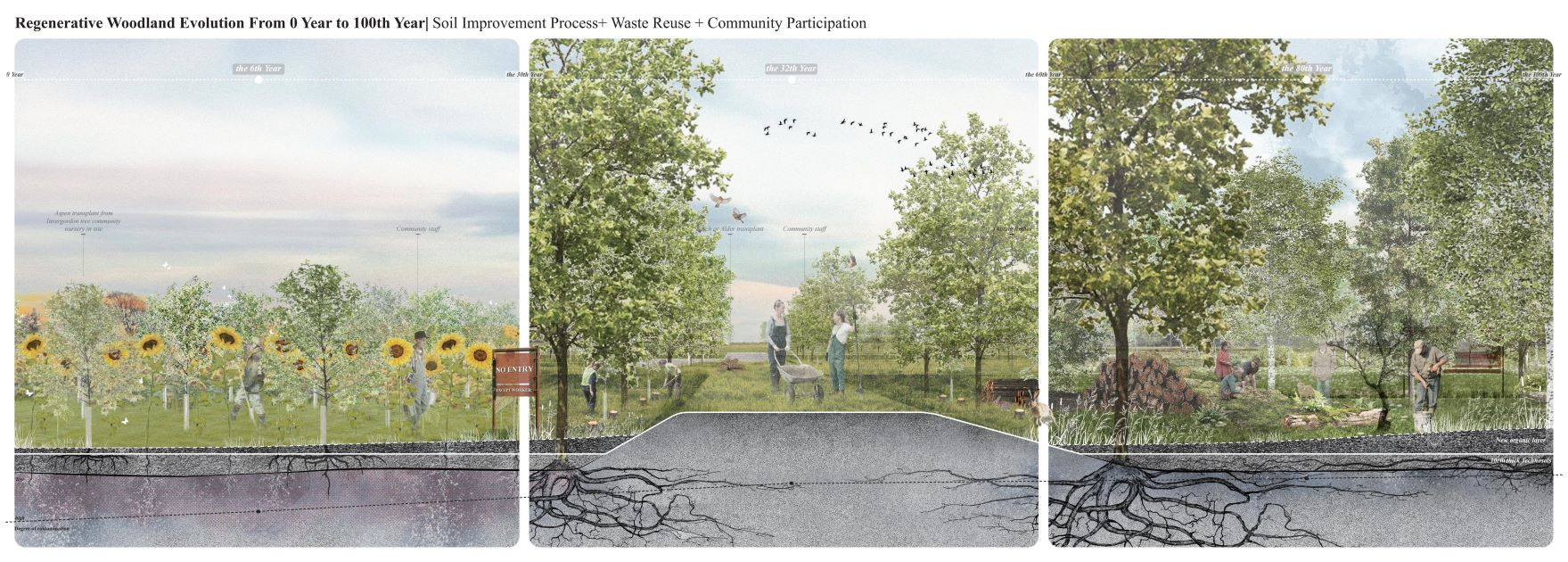
The overarching theme of the site proposal for the first 30 years is "Breaking Boundary: Preparing the Ground for Regeneration."
During this period, the site's metal fencing and stone wall boundaries are partially opened for the first time, accompanied by the reconstruction of key access points.
Given the varying levels of soil contamination across the site, certain pathways are opened to allow community members and visitors to pass through and experience the landscape. In addition, the Tree Community Nursery and sunflower field areas are made accessible — not only contributing to soil remediation and generating economic value, but also providing recreational spaces that promote physical and mental well-being.
The ongoing maintenance of the entire site is entrusted to the Invergordon community, offering local employment opportunities and strengthening community stewardship.
At the same time, the revitalization of this historically significant site is intended to establish a new point of interest in Invergordon, attracting visitors from cruise ships and stimulating the local economy.
The image below presents a proposed bird’s-eye view of the site in its 30th year:
former rigid boundaries have begun to loosen, vegetation thrives, people are reconnecting with the land, birds are gradually returning, and rabbits continue to inhabit the site...
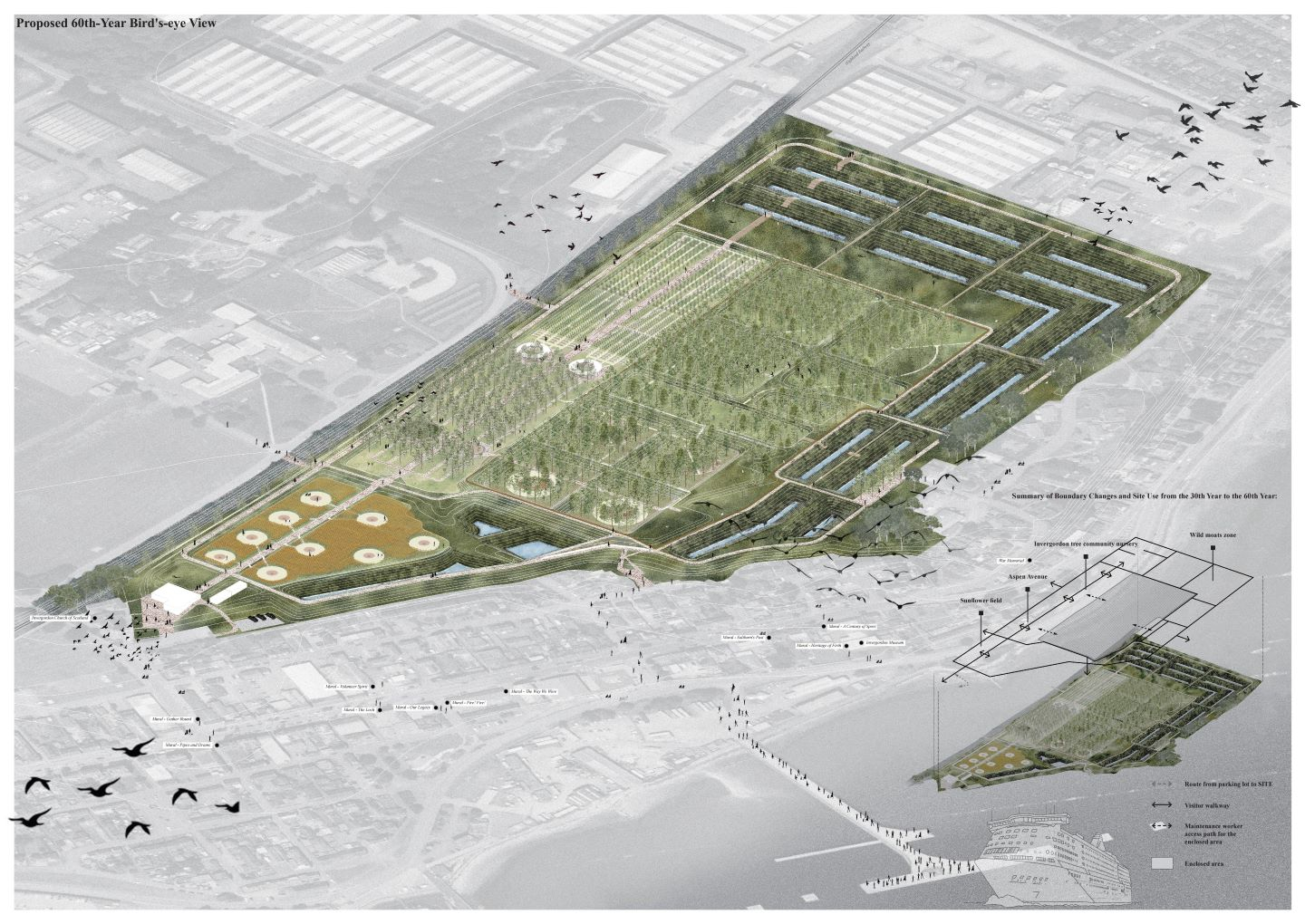
Proposed 60th-Year Bird's-eye View:
From year 30 to year 60, the core theme of the site proposal is "Activating Boundaries: Expanding Internal Spaces."
During this period, the site's metal fence boundaries and stone wall boundaries are fully opened. At the same time, the boundaries are revitalized through the reuse of thinned wood crafted into timber gabions for seating and the kepping of the part of decaying metal fences, as well as the use of Aspen saplings cultivated in the nursery. These strategies not only attracts people into the site but also supports habitats for various species and inspires people's reflection on the transformation of boundaries.
Thanks to further soil remediation over these 30 years, more internal spaces within the site are opened to the public, such as the Aspen Avenue and the Wild Moats Zone.
Walking along the Aspen Avenue, visitors are surrounded by tall, graceful Aspens arranged in a geometric, symmetrical layout, evoking a sense of monumentality. In contrast, the Wild Moats Zone invites people to explore the site’s original wildness, observe remnants of its historical landscape, and encounter diverse forms of wildlife.
The daily maintenance of the entire site continues to be undertaken by the Invergordon community, providing local employment opportunities and strengthening the community’s involvement with the land.
At the same time, the revitalization of this historically distinctive site aims to establish Invergordon as a new point of interest, attracting large numbers of visitors from cruise ships and contributing to the development of the local economy.
The image below presents a proposed bird’s-eye view of the site in its 60th year:
the once rigid boundaries have been completely broken open, vegetation flourishes abundantly, and people’s connection with the land deepens day by day through their visits and participation. Birds and rabbits thrive happily here — and perhaps, in turn, they have begun observing human behavior...
Proposed 100th-Year Bird's-eye View:
Most interventions are completed within the first 60 years.
Afterward, the site proposal enters a new phase with the theme of "Extending Outward: Integrating with Broader Ecological and Community Networks."
The site fully embraces a state of coexistence, openness, and inclusivity.
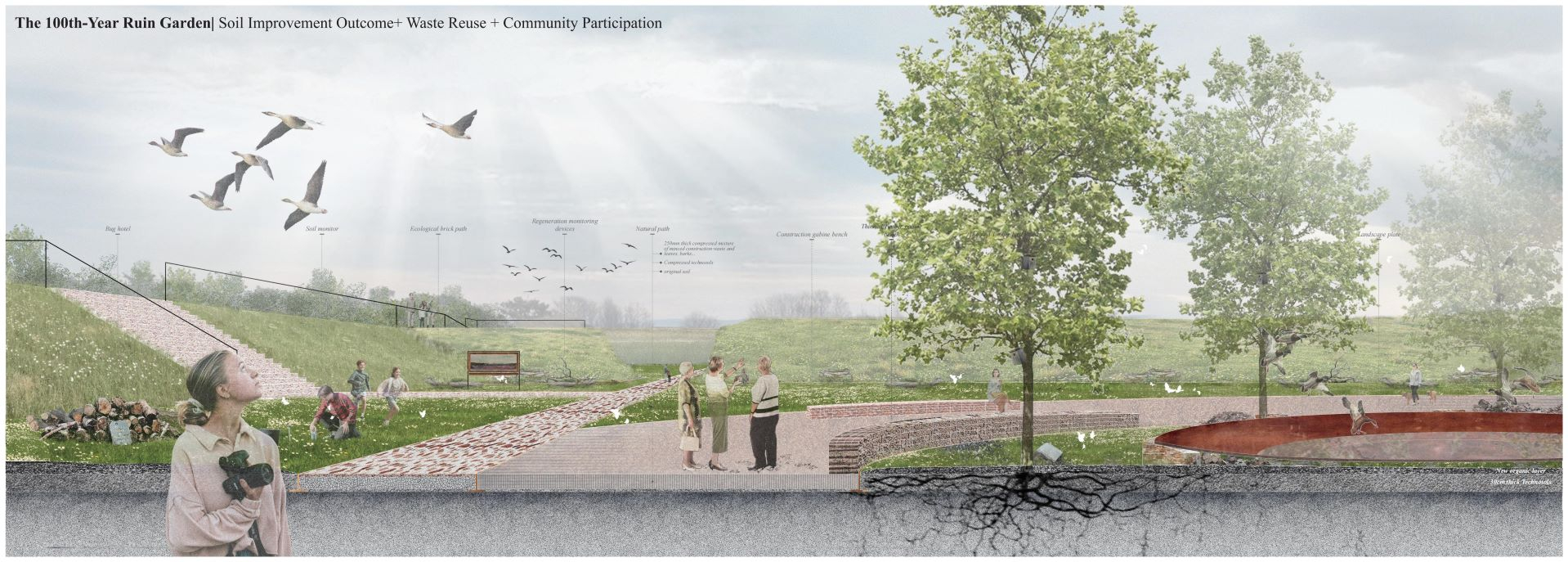
Key areas — including the sunflower fieldtrip, Aspen Avenue, Tree Community Nursery, wild moats zone, ruin garden, and regenerative woodland — are all opened to the public, offering diverse experiences for visitors and residents alike.
These spaces also provide vital habitats for a wide range of birds, rabbits, and insects, supporting their movement, nesting, and survival across the landscape.
The entire site continues to be maintained by the Invergordon community, providing long-term employment opportunities and strengthening local stewardship.
At the same time, the revitalization of this historically significant site has created a unique attraction for Invergordon, drawing large numbers of visitors from cruise ships and contributing to the town’s economic development.
Meanwhile, the Nursery at the core of the site continues to grow.
Due to spatial limitations, a transplant cultivation outsourcing model involving community members is introduced. This approach increases production capacity, enhances residents’ incomes, and deepens the bond between the site and the community.
The trees cultivated through the Nursery are used to establish eco-blocks, improving low-value green spaces across the urban area and further integrating the site into a broader ecological and community network.
The image below presents a bird’s-eye view of the site in its 100th year:
the once rigid boundaries have vanished, replaced by a thriving and hopeful Invergordon.
Industry once brought both prosperity and scars; now, it brings renewal and hope.