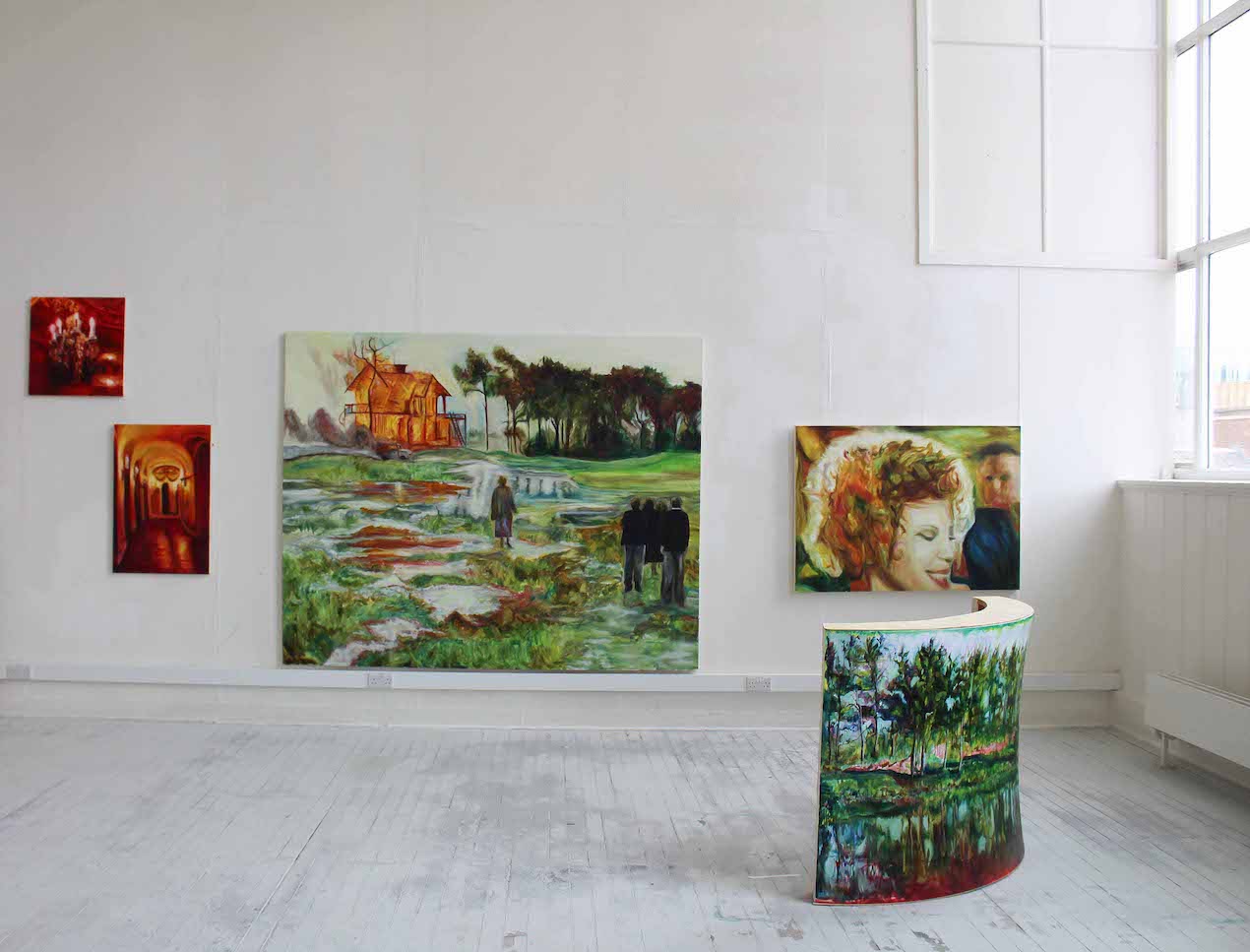
My paintings investigate contemporary landscape, utopia and disaster, and the line between reality and fiction. I use found imagery of model villages and film sets (from old postcards and archives) to conduct a slow, meticulously painted enquiry into these strange settings, which are semi-real to start with: made to be looked at, not lived in. In film sets and model villages, the utopian and often unfeasibly beautiful coexists with the presence of disaster, condensing societal dreams and nightmares into miniature and temporary form. Architecturally, they often recreate—in an ideologically weighted and idealised way—the past, or a version of the past, for our entertainment: and so allow me to look at how history is played out, fictionalised, and reformed in the present. Inside this utopianism, disaster imagery often breaks out, particularly in the motif of the house on fire (or fake fire), burning continuously without being consumed. The landscapes carry suggestions of narrative, but it is arrested and taken out of time, so the viewer must guess for themselves what has happened, or what is about to happen. All of the model and real people who populate my original source imagery are painted out—but leaving behind their shadows and reflections as a kind of haunting.
I am also engaged in a project of world-building: a sort of wider speculative space, where the paintings, when displayed as a series, link together like scenes from a film, or like adding new houses to a model town. Though each one carries enough detail to be inhabited by the viewer as a complete world, together they are an additive project which multiplies roads, avenues, buildings, mysteries, disasters—a detailed and plausible but yet unreal place for the viewer to consider and explore. This complicated realism is central to my practice through both style and subject matter—the landscapes I paint are full of intricate artifice, and my style itself is built around an endless love of detail. In the end, in this way, realism, detail, and realness are central to the questions I am considering about the importance of artificial visual worlds, the (re)construction of history, the complexity of photography, time, haunting, and painting itself.