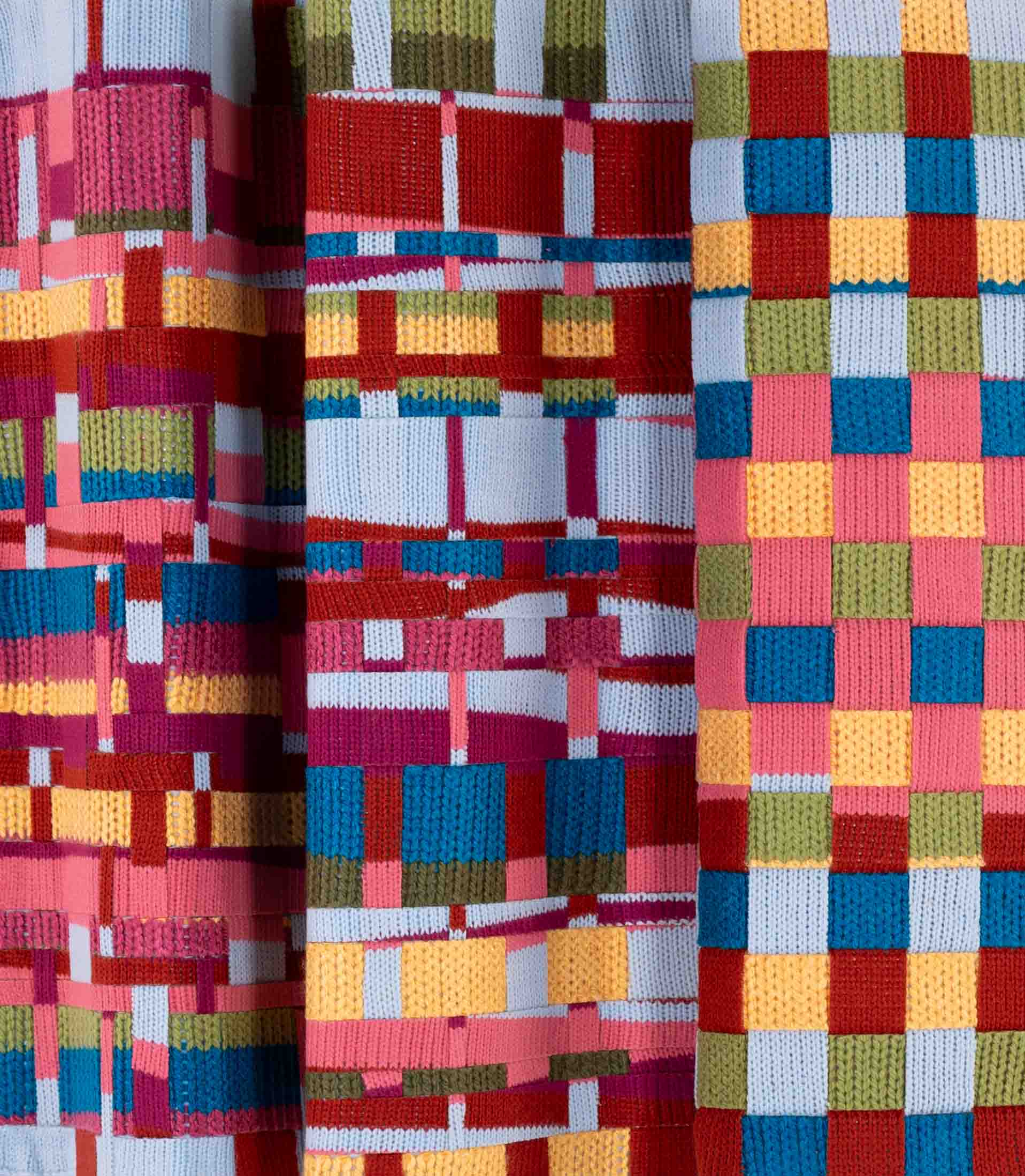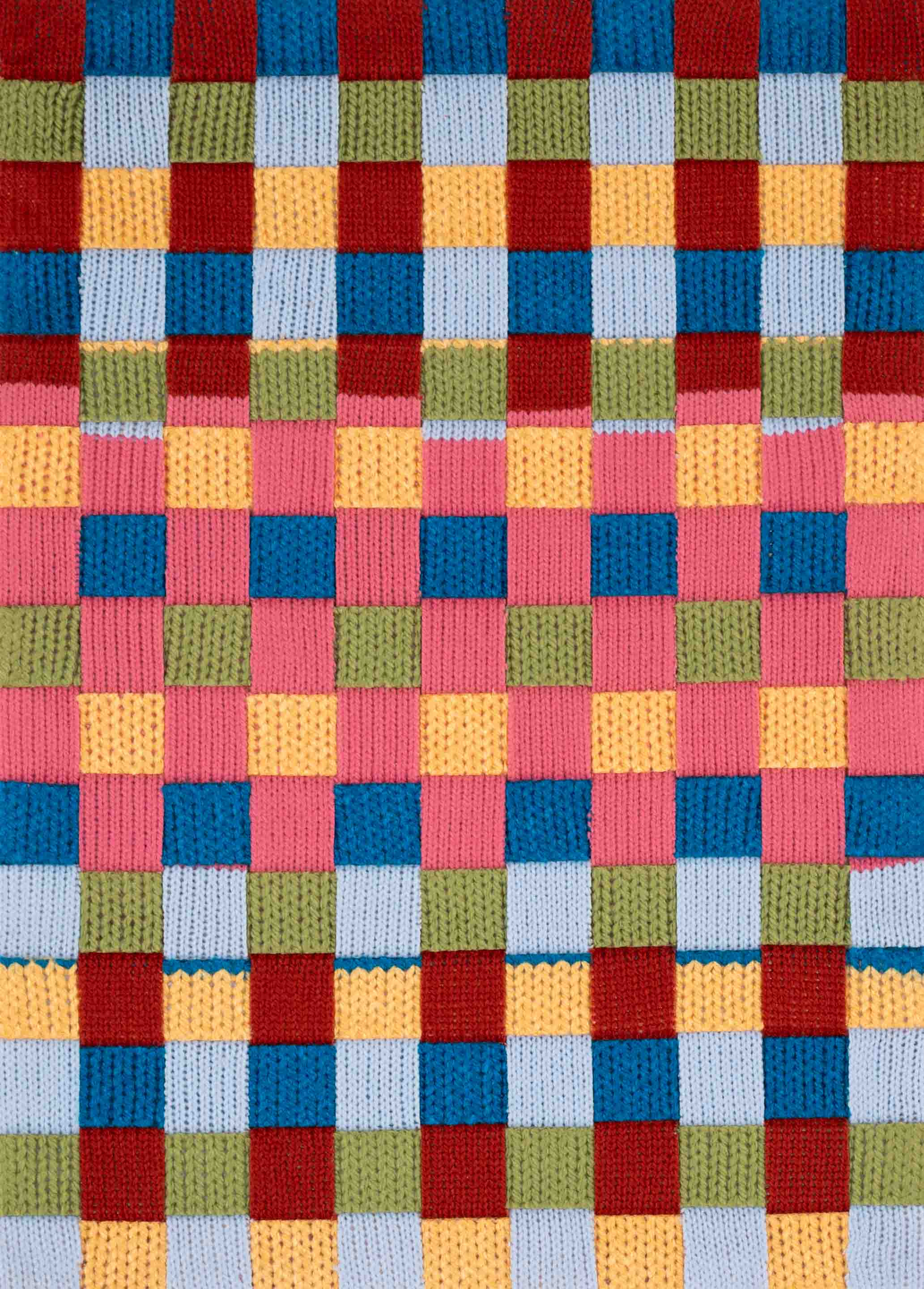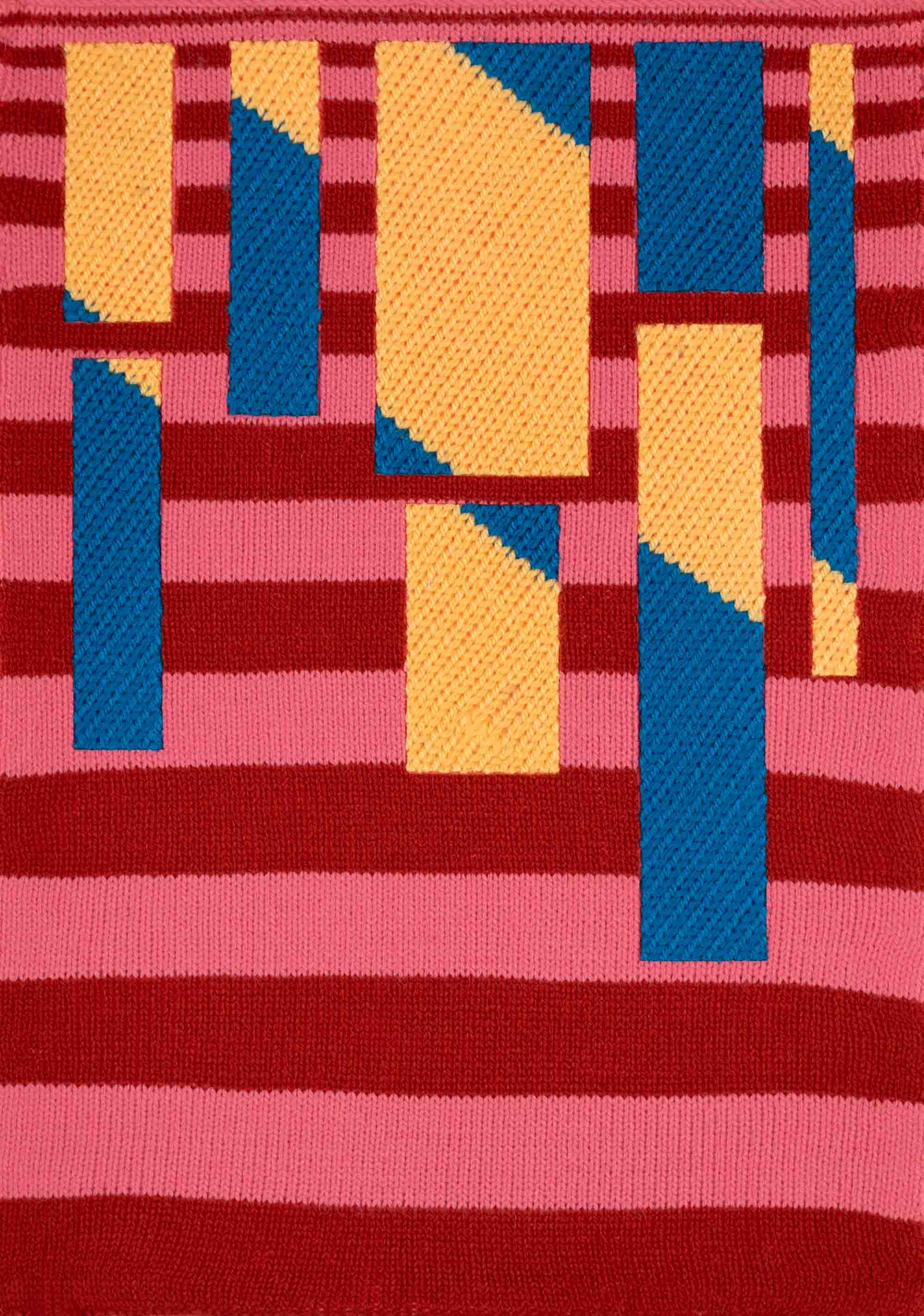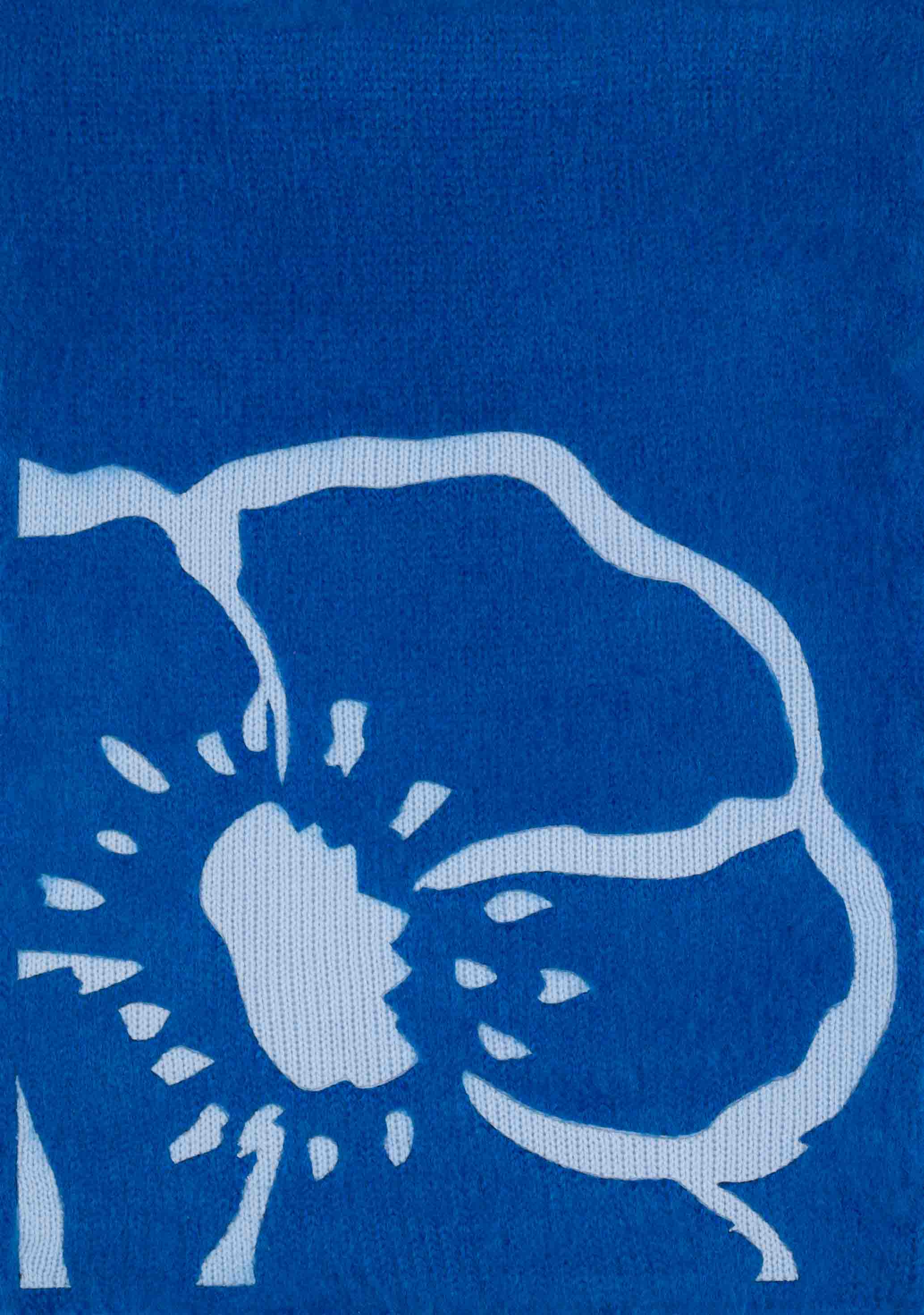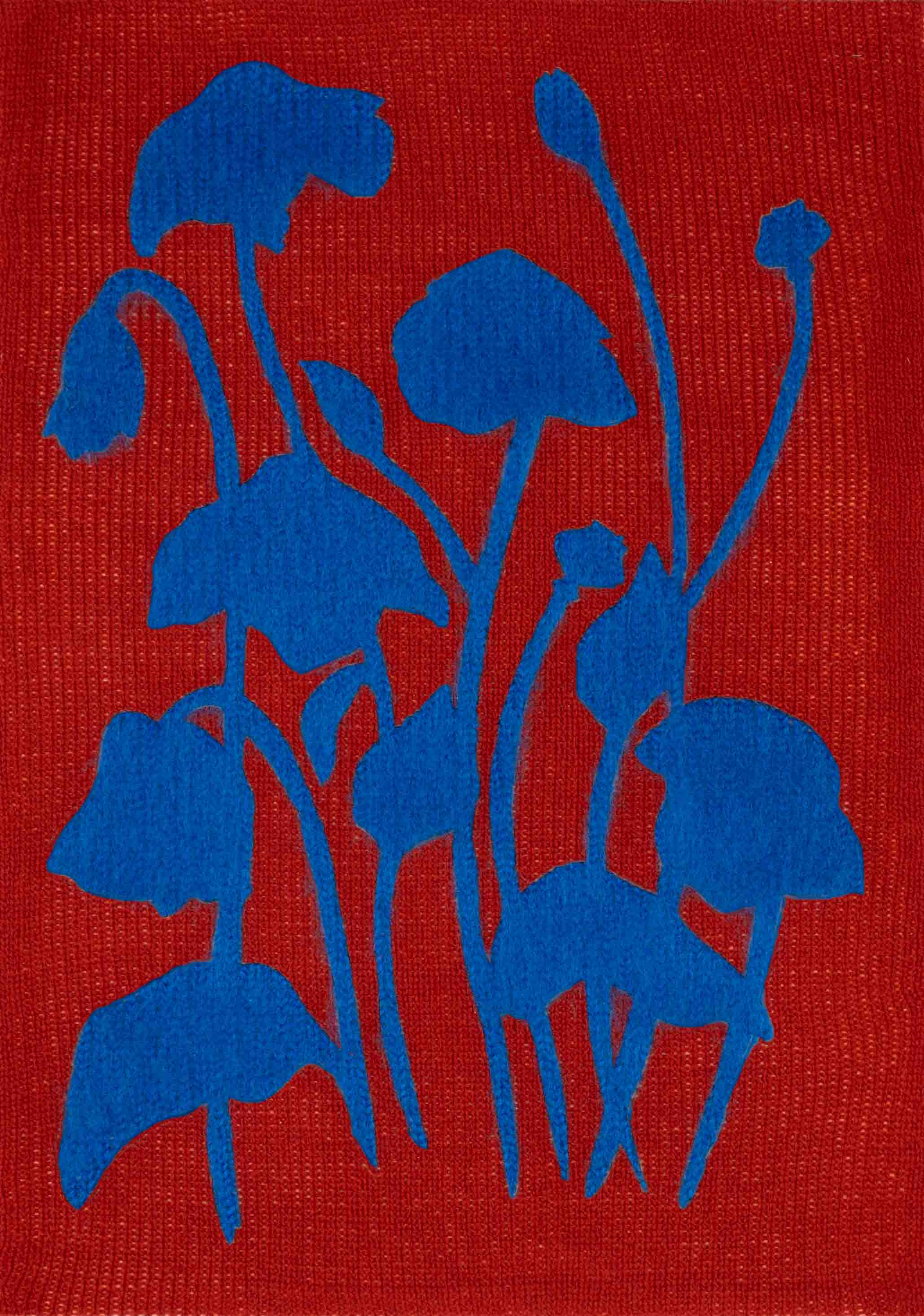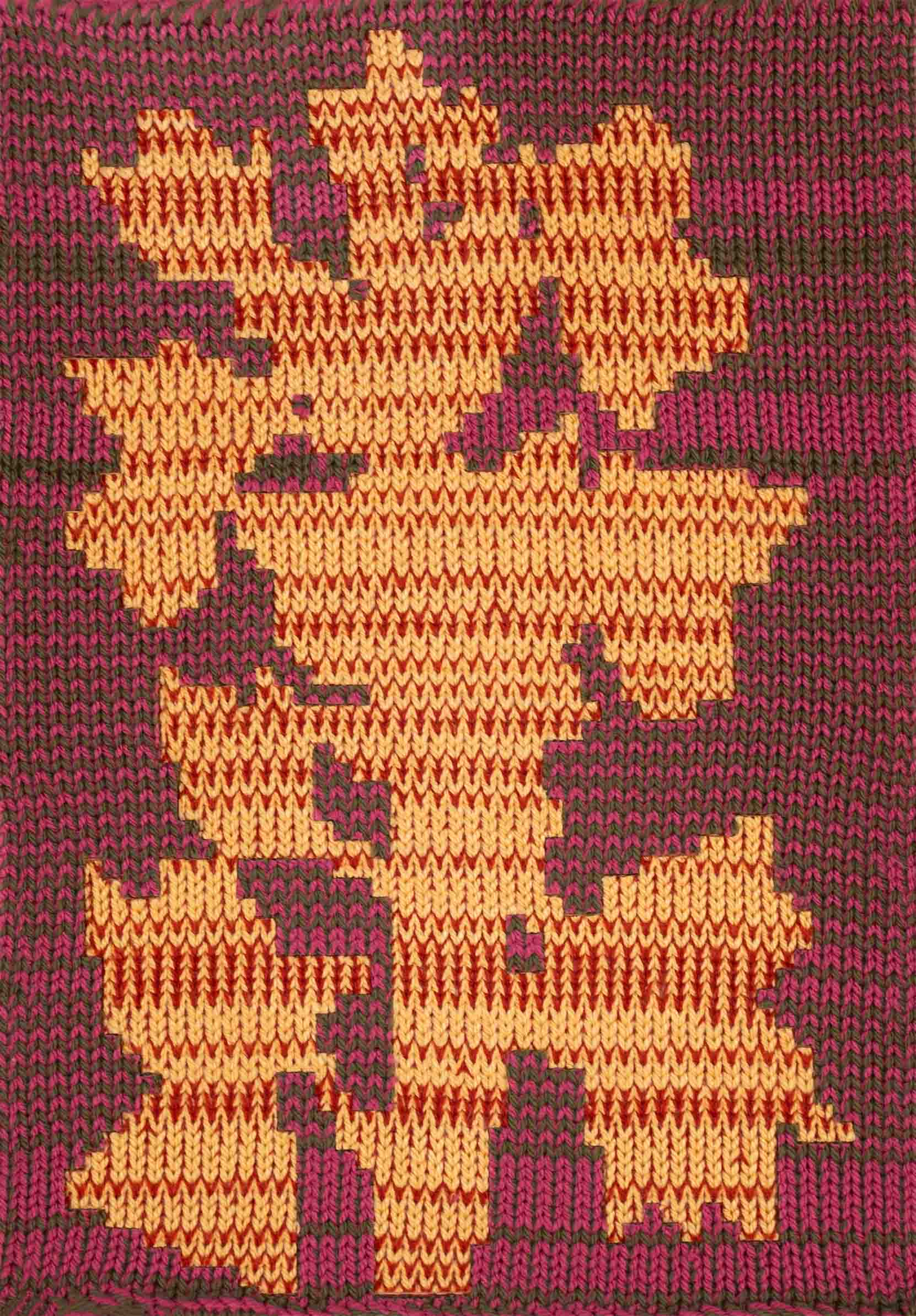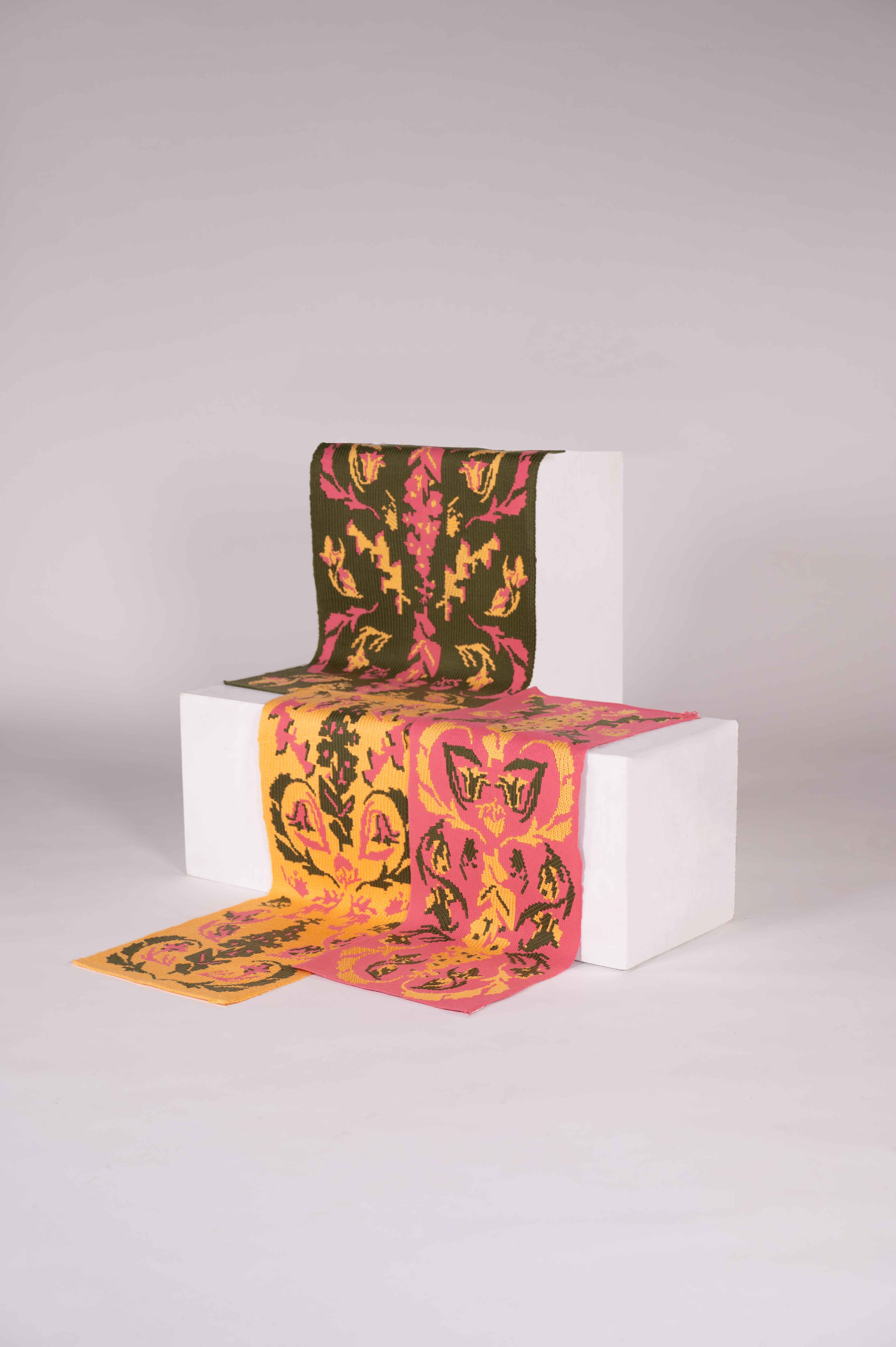


This textile collection explores knitting as a contemporary design practice, rethinking its associations with domesticity through a feminist and sustainable lens. The collection is composed of a series of rug-weight knitted wall panels, designed for interior settings where material, narrative and composition are central to the spatial experience.
Constructed entirely from second-hand yarns, the collection is grounded in a ‘found colour’ approach, where palette and material are determined through sourcing rather than selection. This process is supported by a zero-waste methodology, where knitted panels are laser cut and reassembled into interlocking compositions, allowing materials to be continuously reconfigured across multiple outcomes. Through this, the work combines traditional craft with contemporary processes to create textiles that are both materially conscious and visually resolved.
The collection is structured across three sub-collections, Inherited, Interpreted and Reconstructed, which trace the evolution of floral motifs into increasingly abstract geometric forms. This progression reflects a broader narrative of femininity, moving from historically defined ideals towards more fluid and self-determined expressions. Alongside this, the Reclaimed sub-collection extends the technical development of the work through material and process experimentation.
Positioned within the high-end bespoke interiors market, the collection is designed for spaces that value craftsmanship, material integrity and narrative-driven design. Each panel operates as both a functional textile and a considered visual statement, offering adaptable compositions that respond to different interior contexts. Through the integration of reclaimed materials, tactile processes and embedded storytelling, the work aims to create textiles that not only occupy space, but contribute meaningfully to it.
The Inherited sub-collection draws on floriography to explore traditional Victorian constructions of femininity, using fully floral motifs to create dynamic compositions across three panel scales. The selected flowers act as symbolic carriers of meaning, reflecting how femininity has historically been defined through ideals of beauty, virtue and emotional sensitivity.
Motifs such as the orchid, lily and tulip reference qualities of delicacy, purity and admiration, echoing cultural narratives that positioned women as ornamental and morally refined. Within this context, femininity was often associated with the domestic sphere, where expression was channelled through decoration, subtlety and visual language. Flowers became a means of communicating identity, emotion and social value in ways that were both coded and constrained.
Additional motifs, including the iris, poppy and peony, introduce themes of memory, devotion and aspiration, suggesting the emotional depth that sits beneath these surface ideals. Together, the compositions reflect a version of femininity that is both constructed and inherited, shaped by expectation yet rich with symbolic meaning.
By working with floral forms in their most recognisable state, this sub-collection establishes the foundation of the narrative, presenting femininity as it has traditionally been understood, before it is transformed in later stages of the collection.

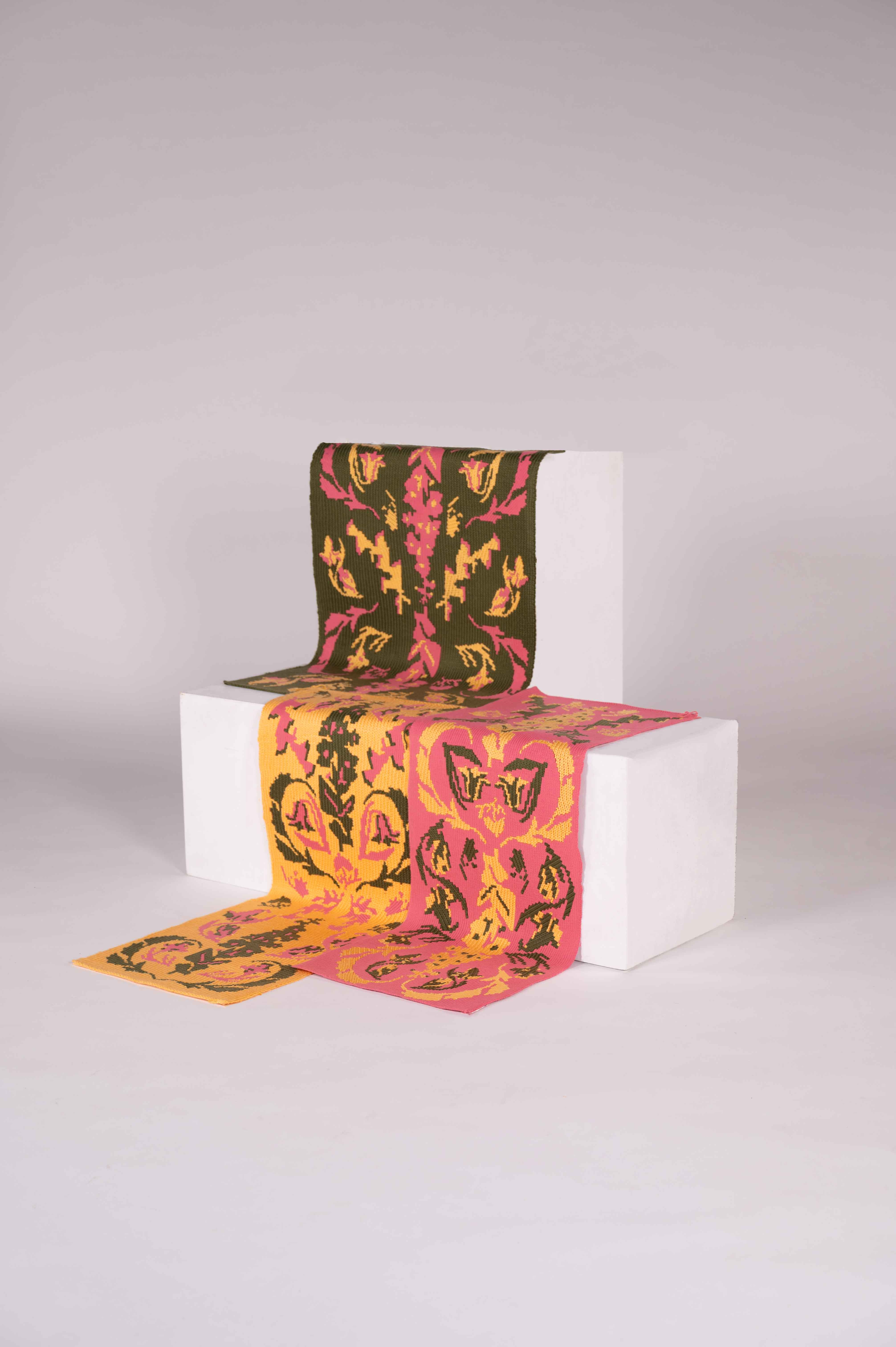
The Interpreted sub-collection marks a transition within the narrative, where traditional floral motifs are translated into pixelated forms and arranged into more structured compositions. Referencing the symmetry and repetition of damask wallpaper, these designs introduce a sense of order and control, shifting the floral motifs from expressive symbols into organised systems.
The process of pixelation draws directly from knitting punch cards, where imagery is broken down into a grid to be mechanically reproduced. By applying this visual language, it extends the technical methodology into the design itself, embedding the logic of knitting within the surface pattern. As a result, the motifs begin to lose their naturalistic qualities, becoming simplified and mediated through structure.
The floriographic references within this stage, including the dicentra, hyacinth and daffodil, suggest a shift in the narrative of femininity. While still rooted in symbolic meaning, these flowers introduce themes of change, resilience and emotional complexity, reflecting a movement away from fixed ideals and towards a more self-defined identity.
The compositions present femininity as something in transition, no longer purely inherited, but actively reinterpreted through systems, structures and processes. This stage is a bridge within the collection, where traditional symbolism is not abandoned, but reworked into a new visual and conceptual language.

The Reconstructed sub-collection represents the final stage in the evolution of the feminine narrative, where floral imagery is fully abstracted into geometric forms. Derived from highly pixelated drawings, the original motifs are broken down to a point where their source becomes almost unrecognisable, leaving behind a language of shape, structure and composition.
This process of extraction transforms the florals into a new visual system, where meaning is no longer communicated through recognisable symbols, but through arrangement, rhythm and spatial relationships. The softness and ornamentation associated with the original imagery is replaced with clarity and precision, signalling a shift away from traditional representations of femininity.
In this stage, femininity is no longer defined by inherited symbols or interpreted through existing systems, but reconstructed into something independent and self-determined. The work reflects a form of identity that has moved beyond expectation, existing instead as a fluid and adaptable visual language.
By translating the collection into a fully geometric aesthetic, this sub-collection also extends its relevance within contemporary interiors, offering a more abstract and versatile application of the narrative. In doing so, it broadens the potential audience while maintaining the conceptual foundations established throughout the collection.

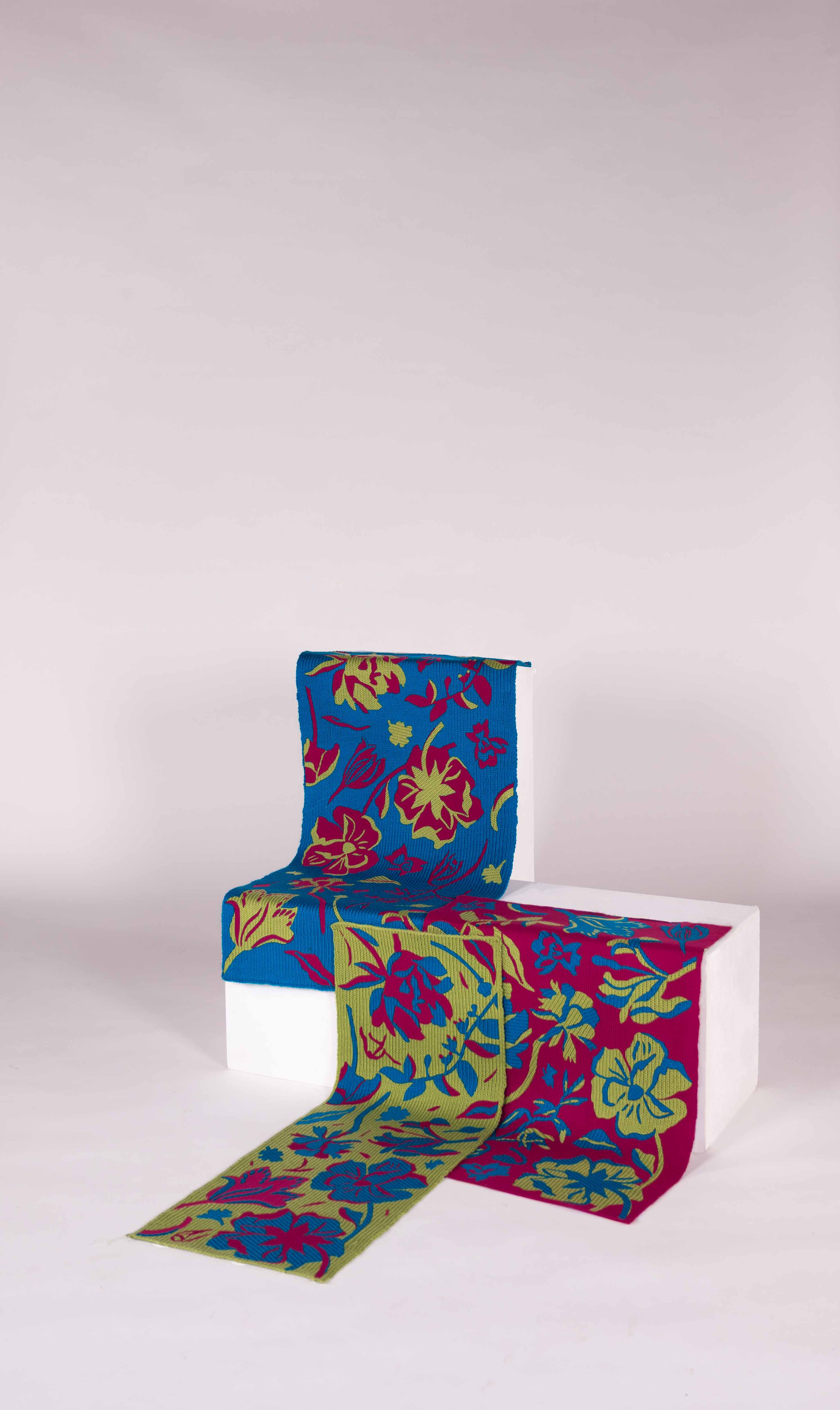

The Reclaimed sub-collection focuses on the continued development of the collection’s core technique, using experimentation to expand the possibilities of laser cutting knit. Building on the established methodology, this body of work explores how knitted surfaces can be further manipulated, de-constructed and reassembled through alternative processes, positioning making as an ongoing site of investigation rather than a fixed outcome.
New approaches are introduced through the weaving of cut knitted strips back into the panel structures, creating layered compositions that disrupt and reconfigure the original surface. Variations in construction are explored by knitting stripes directly into the panels, introducing more complex compositions within the base panels and allowing colour and structure to interact in more dynamic ways. The incorporation of synthetic mohair introduces a contrasting softness and tactile variation, while knitting with multiple yarns simultaneously produces subtle shifts in density and surface depth across the work.
Through these investigations, the sub-collection moves beyond a fixed methodology and into a more exploratory practice. This sub-collection positions the technique not as a resolved outcome, but as an evolving process, where material, structure and method are being continuously redefined.