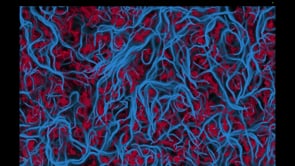
This work is a audiovisual installation themed on “life”, composed of two independently running sub-modules: artificial life and natural life. The artificial life module features an alife-based visual, together with a concatenative synthesiser. The natural life module consists of a Max patcher (presenting video of human fertilised eggs and generating melodies) and an Ableton project (receiving MIDI notes from Max to drive instrumental performance). Each sub-module is equipped with an interaction tool, allowing the audience to manipulate sound and visuals in real time through hand gestures. At the same time, internal interconnections exist within each module: In artificial life, visuals directly influence sound generation in real time; In natural life, sound drives changes in the visual effects.
My motivation for creating this work arises from an interest in posthumanism. In A Cyborg Manifesto (Original work published 1985), Donna Haraway questioned the traditional binary between humans and machines, arguing that the relationship between the two is blurred, and that the distinction between who creates and who is created is no longer clear. Returning to the field of art, I am fascinated by the question: what will sound be like when it emerges in non-human environments or through non-human agencies? While some may fear that the central position of the human will be diminished, I strongly agree with Žižek’s assertion that this is the future: the fusion of human consciousness and computers (not the replacement of the former by the latter). Interestingly, Kenneth Goldsmith makes an intriguing point: “While the author won’t die, we might begin to view authorship in a more conceptual way: perhaps the best authors of the future will be ones who can write the best programs.” As a programmer, I consider coding itself as an act of agency. I aim to let non-human code and data generate nonlinear sound and music, giving rise to two distinct forms of life.